
City Ogden, Weber County
The largest city in northern Utah, and home of the Weber County offices
Ogden, Utah, where the railroads met
About 89,500 people on 27.5 square miles at the foot of the Wasatch, older and denser than the newer cities down the freeway. Inside the city are a state railroad museum, a sculpture park, a county fort on the river bottoms, a 152 acre nature preserve, an 1893 mansion that shows art for free, and a downtown built at the scale of a much bigger place. This is the guide to everything The Local has written about Ogden, with ten deeper pages and the price of every gate.
 By Scott Buehler, Moving Utah
Updated October 2026
By Scott Buehler, Moving Utah
Updated October 2026
The short answer
Weber County's offices are in Ogden, the largest city in northern Utah, with about 89,500 people on 27.5 square miles against the foot of the Wasatch, roughly 38 miles north of Salt Lake City on I-15. It is older and more compact than the cities that grew up around it, and it carries a load of institutions its size would not predict: a state railroad museum, a county fort, a sculpture park, a 152 acre nature preserve, a university on the East Bench and a federal tax processing center. The reason is 1869, when the transcontinental railroads met just west of here and the town became the crossroads of the Intermountain West. This page is the map to it, and it hands the canyon, the reservoirs and the ski hills to the wider Ogden valley pages that all fourteen Weber and Morgan towns share.
The city itself
A dense older city at the foot of the mountains, carrying more than its size explains
Ogden sits where the Wasatch wall meets the valley floor, with the Ogden and the Weber rivers cutting through it and a canyon opening on its east side. It holds about 89,500 people on 27.5 square miles, roughly 3,180 to the square mile, which is the plainest way to say it is older and more compact than the newer cities down I-15. The street grid, the brick downtown and the housing across the original core all read that way.
What the size does not predict is the institutional load. Inside the city are a state railroad museum and three others under one roof at Union Station, a sculpture park on Park Boulevard that drew more than a hundred thousand visits in a single year, a 26 acre county fort in the river bottoms, a 152 acre private nature preserve, an 1893 mansion that shows art for free, a university with a 1,408 seat auditorium, and a federal tax processing center. A town this size does not normally carry that list, and the reason is 1869: the railroads met just west of here and everything since was built on the ground they cleared.
One habit is worth building before you plan around anything here. Some of the biggest green spaces inside the city are not city parks. Fort Buenaventura and Observatory Park belong to Weber County, the Ogden Nature Center is a private nonprofit on 152 acres, and the sculpture park is city owned but run by a foundation, so none of them appears on the city's own parks list even though all of them are in Ogden. An address that reads Ogden does not always sit inside the city either, because the post office files a wide stretch of the valley under an Ogden label. When something matters, from a school to a park, check which body actually runs it. The Ogden city guide carries the practical side of a move, the prices, the neighborhoods and the school boundaries.
The railroads made Ogden the crossroads of the Intermountain West, and the museums, the downtown and the street grid they left behind are still the shape of the city.
A weekend in town
Enough to fill two days without leaving the city
You can fill a weekend inside the city limits without touching the canyon, the reservoir or a ski lift, which is the opposite of how Ogden is usually sold. The museums at Union Station open Wednesday to Saturday, eleven to four, seven dollars for an adult, at the foot of Historic 25th Street. The Dinosaur Park on Park Boulevard runs long summer hours and a flat twelve dollar gate. The Eccles Community Art Center shows art in an 1893 mansion for nothing, one of the downtown venues most itineraries miss, and the temple block on 22nd Street is a short walk from all of it. Out on the East Bench, Weber State adds a 1,408 seat auditorium and a free campus gallery.
The catch is the calendar. Ogden's outdoor life concentrates into roughly five months and then thins out. Pools close, the outdoor festivals stop, and the campus galleries go dark over the summer term and university breaks. The year in Ogden lays the festivals out month by month, and a visit in February is a different city from a visit in July.
Check the day of the week before you drive to any of it. Ogden's paid attractions keep narrow weeks. The museums at Union Station open four days, Wednesday through Saturday. The Treehouse Museum is open only Thursday to Saturday this season, the nature center closes Sunday, and the Weber State galleries close for university breaks and the summer term. A Sunday or a Monday here is a walking day and a park day, not a museum day.
The canyon and the water
The canyon, the reservoirs and the ski hills are written once, for all fourteen towns
Ogden shares its scenery with thirteen other Weber and Morgan towns, so The Local writes the shared ground once, at the region level, rather than repeating it on every town page. Six pages carry it, and this is where the canyon, the water, the ski hills, the old railroad street and the bench trails live.

East of the city
Ogden Canyon
The steep canyon that climbs from the city's east edge up to Pineview and the Ogden valley.
Read
Up the canyon
Snowbasin and Powder Mountain
The three ski resorts above the valley, and the honest case for choosing between them.
Read
Behind the dams
Pineview and Causey
The Ogden River's two reservoirs, the water most of the county heads to in summer.
Read
Downtown Ogden
Historic 25th Street
The old railroad street from the depot up, its brick storefronts, restaurants and bars.
Read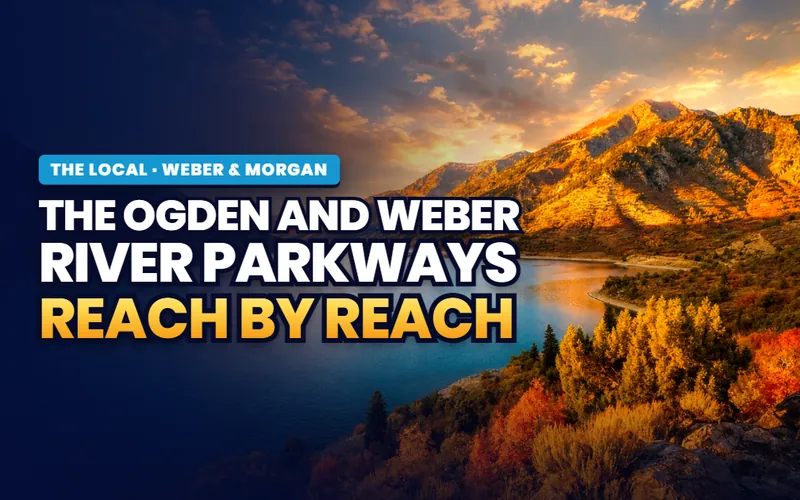
Along the rivers
The Ogden and Weber river parkways
The paved river trails reach by reach, with the ponds, sports parks and gardens on them.
Read
Above the city
Ben Lomond and the Ogden bench
Every trailhead on the bench above Ogden, trail by trail, including the ones at the ends of its streets.
ReadThe Ogden companion
Ten pages on the city, one subject at a time
Everything The Local has written about Ogden itself: the ranked list of what is genuinely worth a day, the museums and galleries inside the depot, the sculpture park on Park Boulevard, the county's fort in the river bottoms, the parks and pools and golf courses, Weber State's public rooms and its parking rule, the downtown buildings above 25th Street, the temple block on 22nd Street, the year's festivals, and the practical version for anyone weighing a move.

Things to do
The 11 best things to do
Read
Inside the depot
The Museums at Union Station
Read
Park Boulevard
The Dinosaur Park
Read
Weber County's fort
Fort Buenaventura
Read
Thirty eight parks
The parks, pools and courses
Read
On the bench
Weber State's public venues
Read
Off the main street
Downtown Ogden, beyond 25th Street
Read
22nd Street
The Ogden Utah Temple
Read
The calendar
The year in Ogden
Read
Moving here
Moving to Ogden
Read
Scott Buehler
Moving Utah About Scott
Quick answers
Ogden, answered
The railroad, and what the railroad left behind. Ogden became the crossroads of the Intermountain West after the transcontinental line was completed at Promontory Summit in 1869, and by the late 1800s several railroads met at the foot of one street. What survives is a 1924 depot at 2501 Wall Avenue holding a state railroad museum and three others, a historic district running uphill from its front door, and a downtown built at the scale of a much larger city. Beyond that Ogden is the city end of the canyon: the ski resorts, the reservoir and the bench trails all sit outside the city and are covered on their own pages.
About 89,500 people on roughly 27 and a half square miles, which makes it tighter and older than the newer cities on the same freeway. The 2020 census counted 87,321, and the state's population estimate has held near that since. That works out to about 3,180 residents to the square mile. Weber County's offices are in Ogden, and the city holds roughly a third of the county's residents and a little over half of its jobs.
More than the size suggests. Inside the city there is a state railroad museum and three others under one roof at Union Station, a sculpture park on Park Boulevard that drew more than a hundred thousand visits in a year, a 26 acre county fort with a championship disc golf course, a 152 acre private nature preserve, a 1924 movie palace, a university auditorium seating 1,408, a free art center in an 1893 mansion, two city golf courses and two bike parks. The ranked list on this companion puts eleven of them in order with the hours and the price for each.
No, and the difference matters for anything from a weekend plan to a home purchase. Snowbasin, Powder Mountain and Nordic Valley are all up Ogden Canyon or over Trappers Loop, outside the city limits and in a different jurisdiction, and Pineview Reservoir sits behind a dam at the top of the canyon. They are a drive from Ogden, not something inside it. The Local covers them on region pages that serve all fourteen Weber and Morgan towns, and this Ogden companion links to those pages rather than repeating them.
Less than most cities its size. The museums at Union Station charge seven dollars for an adult, five for a senior, four for a teenager and three for a child, with under threes free. The Dinosaur Park charges a flat twelve dollars for everyone aged two and up. The Ogden Nature Center charges eight dollars for an adult and five for a senior or a child. The Treehouse Museum charges twelve dollars a person from age two. Lorin Farr Pool charges three dollars. The Eccles Community Art Center is free, and so is walking Historic 25th Street.
Yes. Ogden-Hinckley Airport, identifier OGD, at 3909 Airport Road, has carried scheduled Breeze Airways service to John Wayne Airport in Orange County since February 2024, and more than 24,000 people flew the route in 2025. It is one airline and one destination, a couple of flights a week. The day of the week has shifted at least once, so check the airline before you book. Most travelers out of Ogden still use Salt Lake City International, about 40 miles south.
The city runs its own, which surprises people. Ogden City School District covers addresses inside the city limits, and Weber School District covers the rest of the county, so the two interlock around Ogden rather than sitting side by side. Boundaries run parcel by parcel, so confirm the exact school with the district or a third party rating site such as GreatSchools before you rely on it.
One line is. UTA runs the OGX bus rapid transit route, number 603X, with no fare to ride. It covers about five miles, tying Ogden Central Station to McKay-Dee Hospital and running through the Weber State campus on the way, which makes it the answer to campus parking as much as to a fare. FrontRunner, whose northern end is that same station, charges its normal fare and reaches Salt Lake City in a little under an hour.
For the downtown half of the city, yes, which is unusual in Utah. Ogden Central Station sits at the west end of the walkable core, FrontRunner reaches it from Salt Lake City, and Historic 25th Street runs uphill from Union Station with the museums, the theater, the conference center, the temple block and the creative district all inside a short walk. The zero fare OGX line covers the run out to Weber State and the hospital. A car unlocks the rest: the Dinosaur Park, the fort, the nature preserve and the golf courses are spread across the city and none is a short walk from the depot.
Buying or selling a home in Ogden? Let me line up the right local agent
Ogden asks questions no other Weber County city asks in quite the same way: which of two interlocking school districts a given parcel feeds, which side of the East Bench a house sits on, and whether an address that reads Ogden is actually inside the city. Southern Utah is where I work in person, and Weber County is not, so a move here runs as a partnership. I connect you with a partner agent who knows these streets, and I stay on the file for the research and the financing side.
Or call Scott: (435) 357-4345or send Scott a message
Keep going
Continue your Ogden research
Eight more doors into Ogden, chosen for what this page covers.
Questions about Ogden?
Call Scott, send a message, or find out what your Ogden home is worth. No pressure, no obligation.
Referral Disclosure: For moves outside Southern Utah, I can connect you with trusted local agents. If you choose to work with one, their brokerage pays my brokerage (Real Broker, LLC) a referral fee from their commission. This costs you nothing extra, and you are never obligated to use my referral.