
Box Elder County Garland
The company town at the north end of the Bear River Valley
Garland, the company town that outlived its company
The quiet, residential half of the Bear River Valley twin towns, about 2,920 people two miles north of Tremonton. Garland grew up around a beet-sugar factory that opened in 1903 and ran until 1978, and its silos still stand on Factory Street. Four pages on the town, with the wider county written once and linked.
 By Scott Buehler, Moving Utah
Updated October 2026
By Scott Buehler, Moving Utah
Updated October 2026
The short answer
Garland is a Bear River Valley town of about 2,920 in northern Box Elder County, a company town that grew up around the beet-sugar factory completed on Factory Street in 1903 and outlived it when the plant closed after the 1978 harvest. It is the residential, heritage half of the twin towns it forms with Tremonton, and it keeps no grocery store of its own. The landmarks and the everyday texture live on the four pages below, and this hub is the map to them. The wider county, from the railroad west to the orchard corridor south, is written once and linked.
The shape of it
A town built by a sugar factory, and still here after the factory went quiet
Garland exists because of sugar. It began as a canal camp called Sunset when crews started digging the Bear River canal in 1889, took the name Garland in 1895, and grew up around the beet-sugar factory that opened on Factory Street in 1903. The plant was completed by the Utah Sugar Company and run for most of its life by the Utah-Idaho Sugar Company, and it set the town's streets, its rail spur, and the rhythm of the fall beet campaign. It ran until the 1978 harvest. The factory is largely gone now, but the silos, a warehouse foundation, and a smokestack remnant still stand east of town, best seen from the road since the ground is private. The sugar factory tells that story in full.
Garland and Tremonton run as one community with two Main Streets. Tremonton's 300 East slides north into Garland's Main Street with no visible break, and the two towns split the work between them: Tremonton holds the hospital, the grocery stores, and the bigger errands, while Garland keeps the valley's high school, the 1914 Carnegie library that still lends books, and the restored Tabernacle at the town center. Garland is the quieter, more residential half, about two miles up the road, and it has never had a supermarket of its own.
This hub keeps to the overview and sends the detail to the four pages below. The landmark things to do, the town's Wheat and Beet Days festival, the sugar factory the whole place grew around, and what living in Garland is actually like each have their own page. The practical side of a move, the prices, the schools, and the live listings, sits on the Garland city guide.
The company left after 1978. The silos, the high school, and the Carnegie library stayed.
The wider county
The valley's big days out belong to the whole county, written once
The marquee outings around Garland, the golden spike, the hot springs, the fruit stands, the salt-flat earthwork, sit at the county level rather than being retold on each town page. These six carry them. Garland points to them here and keeps its own four pages close to town.

West to Promontory
Golden Spike
The ceremonial last-spike site from May 1869, where rails built from east and west finally met, up on the dry Promontory summit.
Read
The far northwest
Spiral Jetty
Robert Smithson's basalt coil on a remote arm of the Great Salt Lake, far out past the railroad.
Read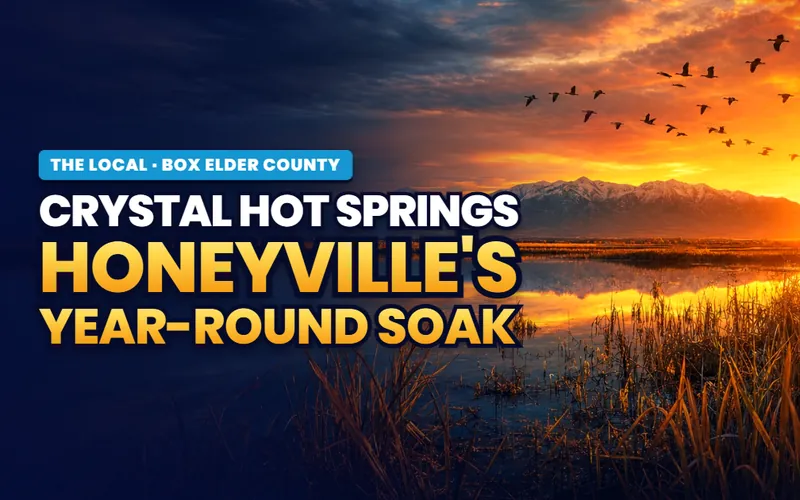
South to Honeyville
Crystal Hot Springs
Geothermal soaking pools and slides at Honeyville, a short run south down the highway.
Read
Down US-89
The Fruit Way
The orchard-stand run along US-89 through Willard and Perry, at its best from midsummer into fall.
Read
East up the canyon
Sardine Canyon and Mantua
The highway climb toward Cache Valley and a spring-fed reservoir tucked in the mountains.
Read
The valley floor
Bear River Valley farm country
The wheat ground, the dairies, and the wildlife areas that spread across the valley around town.
ReadAll six live under the Box Elder County region hub, the way into every town in the county.
The Garland companion
Four pages on Garland itself, from the silos to Friday-night football
Everything The Local has written about Garland: the landmarks worth a stop, the festival named for the crops that built the town, the factory the whole place grew around, and what daily life here is actually like. Each is its own page, and this is the map to them.

Things to do
Top 4 things to do
The honest short list: the Carnegie library, the Tabernacle, the city park, and Friday-night football.
Read
Every August
Wheat and Beet Days
The town festival named for wheat and sugar beets, with a parade, a free 5K and fireworks.
Read
On Factory Street
The sugar factory
Why the town exists, and what still stands of the beet-sugar plant it grew around.
Read
Everyday life
Living in Garland
The high school, the credit union, the drive to the grocery store, and the move-in math.
ReadWeighing a move, not a visit?
The Garland city guide has the prices, the schools, the buyer's-eye neighborhoods, and every active listing in town.
Scott Buehler
Moving Utah About Scott
Quick answers
Garland, answered
Its beet-sugar factory and its quiet, residential feel. Garland is a Bear River Valley town of about 2,920 in northern Utah that grew up around a sugar-beet refinery built in 1903, and the factory silos still stand on Factory Street east of town. Today it is the calmer, heritage half of the twin towns it forms with Tremonton, holding the valley's high school, a 1914 Carnegie library, and the Tabernacle at its center.
The U.S. Census estimates Garland at about 2,920 people in 2025, up from 2,589 at the 2020 census, which makes Garland a small town rather than a full-service city. It leans residential and agricultural, with a city hall, a credit union branch, a convenience store, and the schools, while the hospital, the grocery stores, and most shopping sit two miles south in Tremonton.
Garland sits in the Bear River Valley in northern Box Elder County, about two miles and five minutes north of Tremonton, with which it shares one continuous main road. Brigham City, where the county offices are, is roughly 20 minutes south, Ogden and its FrontRunner station about 40 minutes, and Salt Lake City around an hour and fifteen minutes down I-15 and I-84.
Partly. The beet-sugar plant that built the town closed after the 1978 harvest and was largely dismantled, but the silos, a warehouse foundation, and a smokestack remnant still stand east of town on Factory Street. The ground is private, so the remains are best seen from the road rather than up close.
Garland's own list is short and landmark-based: the 1914 Carnegie library, the restored Tabernacle, Garland City Park, and a Bear River High football game on a Friday night, when much of the valley turns out. Its August festival, Wheat and Beet Days, is the big weekend. Bigger day trips, from Crystal Hot Springs to Golden Spike, sit a short drive out and are covered at the county level.
No full supermarket. The Garland Kwickstop covers gas and convenience items, but a real grocery run means the two-mile hop south to Ridley's or Kent's Market in Tremonton, about five minutes away. It is the clearest sign of how the two towns divide the everyday work between them.
Garland's town festival, also called Garland City Days, held in early August, a long-running tradition. It is named for the wheat and sugar beets that built the local economy, and it fills Garland City Park and Main Street with a parade, games, a car show, a free 5K, free rides and fireworks. Events change from year to year.
A 1914 library building funded by the Carnegie program that is still the working city library today, one of the Carnegie libraries left in Utah. It sits on Factory Street and anchors the town's civic center along with the Tabernacle.
It is a hub and four guides. This page is the overview and the map: the ranked things to do, Wheat and Beet Days, the sugar factory, and everyday life in town. The wider county, from Golden Spike out to the Fruit Way, is written once at the county level and linked from this page.
A quieter valley town, worth a straight answer
Garland asks a household a plain question: whether the residential, low-key half of a twin town, with the grocery run and the hospital two miles down the road in Tremonton, is the tradeoff you want. Tell me what you are weighing and I will introduce you to a Box Elder County partner agent who knows these streets, and stay on the file for the research and the financing side.
Or call Scott: (435) 357-4345or send Scott a message
Keep going
Continue your Garland research
Eight more doors into Garland, chosen for what this page covers.
Questions about Garland?
Call Scott, send a message, or find out what your Garland home is worth. No pressure, no obligation.
Referral Disclosure: For moves outside Southern Utah, I can connect you with trusted local agents. If you choose to work with one, their brokerage pays my brokerage (Real Broker, LLC) a referral fee from their commission. This costs you nothing extra, and you are never obligated to use my referral.