
Cache Valley Wellsville
Cache Valley's oldest town, at the foot of the Wellsvilles
Wellsville, where the valley's story starts
About 4,060 people on the west side of Cache Valley, on the ground first settled in 1856 as Maughan's Fort, with the steep Wellsville Mountains rising straight overhead, farm bottoms running out toward the Little Bear River, and Logan a few minutes northeast. Seven pages on the town itself, with the wider valley written once and linked.
 By Scott Buehler, Moving Utah
Updated October 2026
By Scott Buehler, Moving Utah
Updated October 2026
The short answer
Wellsville is the first town anyone built in Cache Valley, settled in 1856 as Maughan's Fort and named a few years later for Daniel H. Wells. It sits on the west side of the valley where the farm ground along the Little Bear River meets the base of the Wellsville Mountains, a range so steep it seems to lean over the town. The pioneer street grid, the 1908 Gothic tabernacle and the Labor Day Founders Day tell you this is old Cache Valley, while Logan and its jobs, campus and shopping sit a few minutes northeast. Use this page as the index to seven deeper Wellsville pages; the canyon, Bear Lake and the ski areas sit on the regional pages that serve the whole valley at once.
The shape of it
Farm ground on the flat, a pioneer grid in the middle, and a wall of mountain on the west
Wellsville reads east to west and flat to vertical. Out on the valley floor, the Little Bear River winds through fields and pasture that have been worked since the first settlers laid out the town. The older heart of Wellsville sits on the bench above that ground, a compact grid of pioneer era lots and churches with the stone tabernacle for a centerpiece. Then the land quits climbing gently and simply goes up: the Wellsville Mountains rise off the valley floor in one abrupt sweep, so steep that from most of town you are looking almost straight up at the ridgeline. That contrast, tame bottomland against a near vertical range, is the whole shape of the place.
Because the mountains pin the town against the valley, Wellsville stays small and stays put. It does not sprawl the way the towns along the highway to Logan do, and a lot of what draws people is exactly that: an old, settled feel with open farm country on one side and wilderness on the other. The living in Wellsville page works through what day to day life here is actually like, by housing stock, setting and commute rather than by who lives where.
From here the page keeps to the overview and points you onward for the particulars. The founding story, the tabernacle and the town's pioneer roots belong to the Wellsville heritage page. The Labor Day celebration and its debated Sham Battle belong to the Founders Day page. The steep trails and the raptor ridgeline belong to the hiking guide, and the ballfields and rec programs to parks and recreation. The practical side of a move, the prices, the neighborhoods for buyers and the schools, lives on the Wellsville city guide.
Tame bottomland on one side, a near vertical range on the other. Wellsville lives in the narrow strip between them.
The wider valley
The shared country of the valley, written once, not once per town
Aggie country, the ski hills, the drive up the canyon and the run over to Bear Lake belong to no single town; they read about the same whether you set out from Wellsville or the far side of the basin. So The Local gives each its own regional page instead of copying it onto every hub. The six cards here open that shared country. Wellsville's own seven pages, listed lower down, stay pointed at the town, its pioneer roots and the wall of rock overhead.

Up US-89
Logan Canyon
The mountain byway that climbs east out of Logan to Tony Grove and the pass.
Read
Over the summit
Bear Lake
The bright blue lake and its roadside raspberry stands, over the top of the range.
Read
The valley's engine
Utah State and Aggie country
The university that runs the valley's economy, well past a game day or a campus tour.
Read
The ski hills
Beaver Mountain and Cherry Peak
The two small ski areas that give the valley its winters, both a short drive off.
Read
The west wall
The Wellsville Mountains
The range as the whole valley sees it, the wilderness and the hawk watch on the ridge.
Read
Dairy and cheese
Cache Valley farm country
The dairy belt and its cheese, the working farm ground Wellsville has always sat inside.
ReadYou will find all six on the Cache Valley region hub, which opens onto every town in the basin, Wellsville among them.
The Wellsville companion
Wellsville itself, gathered into seven local pages
These seven pages are the full record of what we have published on Wellsville proper. Between them they take in what there is to do, the founding and the tabernacle, the Founders Day weekend, the climb into the mountains, the town parks, the feel of living here, and the checklist for a move. Pick whichever one answers the question you arrived with.
Things to do
Things to Do in Wellsville
The best of the town and the range, from the tabernacle and Founders Day to the steep trails straight overhead.
Read
The oldest town
Wellsville Heritage
Maughan's Fort, the pioneer street grid and the 1908 stone tabernacle, the story of Cache Valley's first town.
Read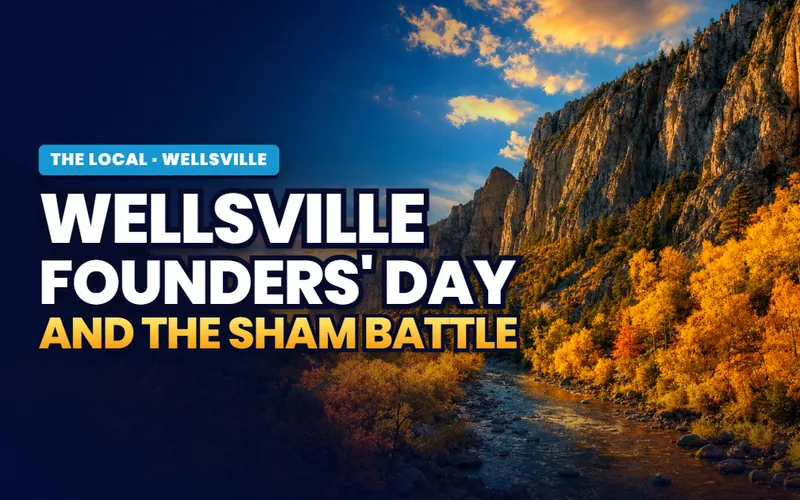
Labor Day weekend
Founders Day and the Sham Battle
The town's oldest tradition, a parade and a much debated frontier reenactment held every Labor Day since 1931.
Read
Straight up
Hiking the Wellsville Mountains
One of the steepest ranges anywhere, the ridge trails, Box Elder Peak and the fall hawk migration.
ReadHere for a move, not a weekend?
Pricing, the neighborhoods buyers actually ask about, school attendance areas and current listings are gathered on the Wellsville city guide.
Scott Buehler
Moving Utah About Scott
Quick answers
Wellsville, answered
Wellsville is the oldest town in Cache Valley, founded in 1856 as Maughan's Fort. It sits at the western edge of the valley where the farm bottoms along the Little Bear River run up against the Wellsville Mountains, one of the steepest ranges in Utah. In town the landmark is the Gothic Revival tabernacle finished in 1908, and each Labor Day weekend the Founders Day celebration and its long running Sham Battle reenactment fill the streets.
Yes. A company of settlers led by Peter Maughan arrived in 1856 and called the place Maughan's Fort, which makes Wellsville the first permanent town in Cache Valley. It was renamed in 1859 for Daniel H. Wells and incorporated in 1866. The valley's larger towns, Logan among them, came afterward.
The 2020 census counted about 4,060 people in Wellsville. It is a small town by valley standards, well under Logan and its bench neighbors, and it has stayed compact on the bench between the mountains and the farm ground on the valley floor.
Wellsville is part of the Cache County School District. Wellsville Elementary serves kindergarten through fifth grade in town, while older students head to South Cache Middle School (grades 6 to 8) and Mountain Crest High School (grades 9 through 12), both in nearby Hyrum, from the 2026-27 school year. For ratings, test scores and current boundaries, check a third party source such as GreatSchools or Niche and confirm the attendance area with the district.
The tabernacle's Gothic Revival exterior, built of stone quarried from the mountains above town and finished in 1908, is the landmark you can always see from the street. The interior has been under a long structural restoration led by the Wellsville Foundation, so inside access varies. If you want to see the interior or arrange a visit, check with the Wellsville Foundation for current status rather than assuming it is open.
Founders Day is Wellsville's Labor Day weekend celebration, held since 1931 to mark the town's founding, with a parade and family events on the streets and in the park. Its best known and most debated tradition is the Sham Battle, a staged frontier reenactment on horseback. The event has been revised in recent years, so check the current year's program before you plan around it.
Very. The Wellsville Mountains rise abruptly from the valley floor just west of town and are often called one of the steepest ranges in the country for how narrow a base they climb from. Box Elder Peak, the high point, tops out around 9,372 feet. Much of the range is protected as the Wellsville Mountain Wilderness, and its ridgeline is a well known place to watch the fall raptor migration.
About 13 minutes. Logan sits about 9 miles northeast of Wellsville, and the drive up US-89 and US-91 takes about 13 minutes, a little more to downtown or Utah State University. Wellsville trades a few minutes of driving for a quieter spot at the foot of the mountains.
Wellsville sits at the Cache Valley end of Sardine Canyon, the US-89 and US-91 climb that carries most traffic between the valley and the Wasatch Front near Brigham City. It is the main way in and out on the valley's west side, and in winter it can pick up snow and wind, so it is worth watching the road report before a storm.
The valley's oldest town, worth getting right
The questions Wellsville raises are its own: whether you want to sit up on the old bench near the tabernacle or out closer to the farm ground, how well the daily drive over to Logan and back suits you, what an older pioneer lot asks of you against a newer build on the edge of town, and how wind and snow through Sardine Canyon fit your idea of winter. Tell me what you care about most, and I will put you in touch with a Cache County partner agent who knows these streets, and stay alongside you through the research and the financing.
Or call Scott: (435) 357-4345or send Scott a message
Keep going
Continue your Wellsville research
Eight more doors into Wellsville, chosen for what this page covers.
Questions about Wellsville?
Call Scott, send a message, or find out what your Wellsville home is worth. No pressure, no obligation.
Referral Disclosure: For moves outside Southern Utah, I can connect you with trusted local agents. If you choose to work with one, their brokerage pays my brokerage (Real Broker, LLC) a referral fee from their commission. This costs you nothing extra, and you are never obligated to use my referral.