
Uintah County, Eastern Utah
Moving to Vernal, Utah
Vernal sits at about 5,300 feet in Ashley Valley, in the far northeast corner of Utah, where US-40 meets US-191. Dinosaur National Monument is about 25 minutes east, and Salt Lake City is about three hours west. Want to see what is for sale right now? The Browse Vernal homes button below shows every listing.
Drive times from Vernal. Look up any Utah drive
Start here
What brings you to Vernal?

Pick one, and I will point you to the right page. It takes three taps at most, and there is nothing to sign up for.
Chapter 1 of 4
The place and the weather
What Vernal is, where it sits, and what the sky does all year.
City at a glance
What are the quick facts on Vernal?
The place
The weather
The money
Around town
Sources: U.S. Census Bureau, NOAA, USGS, and the Utah State Tax Commission. Prices move, so ask me for current numbers.
Overview
What is Vernal like?
Short answerThe largest city in Uintah County, about 10,700 people at 5,300 feet in Ashley Valley, with Salt Lake City about 3 hours west.
Vernal sits at about 5,300 feet in Ashley Valley, in the far northeast corner of Utah. It is the largest city in Uintah County, with about 10,700 people by the 2025 Census estimate. The county offices are in Vernal. Naples, a separate city, touches it on the east and southeast. The whole Uinta Basin comes here to shop.
Two highways cross downtown. US-40 is Main Street, and US-191 is Vernal Avenue. No interstate reaches town, and there is no passenger train. Salt Lake City is about 171 miles and 3 hours west. The town counted 10,079 people in 2020, so growth has been slow and steady. The city covers only about 4.6 square miles, and little open land is left inside it.
The valley takes its name from William H. Ashley, a fur trader who came down the Green River in 1825. A scouting party sent by territorial leaders in 1861 said the basin was good "for nothing but nomad purposes." The first settlers came on February 14, 1873, and built along Ashley Creek. The town site was settled from June 6, 1878. After the Meeker incident in Colorado in 1879, settlers built a fort there, and a town grew out of it.
The town went by Jerico, Hatch Town, and Ashley Center. The Post Office refused Ashley Center and assigned the name Vernal in 1886. Uintah County was created in 1880. The county offices moved to Vernal in 1893, and Vernal became a city in 1897. By 1890 it already had 1,305 people.
Two industries shaped the town. Gilsonite, a mineral named for Samuel Gilson, who found it in 1868, was mined by 1888 and drove the 1890s. A narrow-gauge railroad never reached Vernal, and the town still has no railhead. Oil came in the late 1940s. The population more than doubled from about 2,000 in 1947 to about 5,000 in 1950. It nearly doubled again from 3,908 in 1970 to 7,993 in 1975. The city plan sums it up in one line: "From that time on it has been a boom and bust town." The jobs topic has the numbers.
Downtown has a story of its own. The Bank of Vernal block at 3 W Main used Salt Lake brick for its face. Freight cost far more than parcel post, so the bank had only the face brick wrapped and mailed, in crates of about ten, around 1916. The building was finished in 1917. It later became Zions Bank, and it was listed on the National Register of Historic Places in 2008. The Post Office then capped a sender at 200 pounds a day to one address.
Vernal bills itself as Dinosaurland. Dinosaur National Monument and Flaming Gorge are both within about an hour, and the outdoors topic covers both. The city is planning too. Its General Plan runs from 2020 to 2029 and says Vernal "needs to continue to explore ways to diversify their economy." In 2025 the city bought the Lamplighter Inn block at 120 E Main to plan a town square. A survey that year documented 137 historic properties on Main Street.
Highlights
- About 10,700 people, by the 2025 Census estimate, up from 10,079 in 2020.
- About 5,300 feet high, in Ashley Valley, where US-40 meets US-191.
- The largest city in Uintah County, with the county offices in Vernal.
- Named Vernal in 1886, the county offices came in 1893, and a city since 1897.
- No interstate, no passenger train, and no railhead.
- Salt Lake City is about 3 hours west.
Sources: the Vernal General Plan 2020 to 2029, the 2025 Vernal Main Street survey, KSL, and the Census 2020 count and 2025 estimate. The elevation is from the USGS at City Hall.
Want the street level story? Vernal on The Local has guides to the monument, Flaming Gorge, Red Fleet, and the Field House. Read Living with the boom for the oil and gas story. My relocating to Utah guide covers the wider move.
Still choosing a town?Utah City FinderSort 138 Utah towns by budget, snow, summer heat, and the drive to work.Find a townClimate and weather
What is the weather like in Vernal?
Short answerCold, dry winters, warm summers, and cool nights. Winter highs run about 29 to 37°F.
Vernal is high desert. Winters are cold, summer days are warm, and the nights cool off fast. The town gets only about 9 inches of rain and melted snow in a normal year. September is the wettest month, and November is the driest.
These numbers come from the NOAA weather station in Vernal, about 1.3 miles southwest of City Hall and on the same flat ground. The 1991 to 2020 normals are the official ones for this spot. Compared with Roosevelt, 30 minutes west, summer days run about 4 degrees cooler. Winter nights are milder, and a little more snow falls.
Spring
Highs 51 to 70°F
Cool to mild, and the windiest season. The last freeze usually comes about May 7.
Summer
Highs 81 to 89°F
Warm, dry days and cool nights in the 50s. About 34 days a year reach 90.
Fall
Highs 46 to 76°F
Clear and mild, and September is the wettest month. The first freeze usually comes about October 6.
Winter
Highs 29 to 37°F
Cold, with light snow and nights near 10. Cold, still air can sit in the valley for days.
Month by month
These are the normal highs and lows for each month. Look at how far the temperature falls at night. Even in July, a normal night drops to about 57°F.
- JanuaryHigh 29°F, low 10°F
- FebruaryHigh 37°F, low 17°F
- MarchHigh 51°F, low 27°F
- AprilHigh 60°F, low 34°F
- MayHigh 70°F, low 43°F
- JuneHigh 81°F, low 51°F
- JulyHigh 89°F, low 57°F
- AugustHigh 86°F, low 55°F
- SeptemberHigh 76°F, low 46°F
- OctoberHigh 61°F, low 35°F
- NovemberHigh 46°F, low 24°F
- DecemberHigh 31°F, low 13°F
Source: NOAA climate normals, 1991 to 2020, Vernal station (USC00429111), about 1.3 miles southwest of City Hall.
Cold nights and frost dates
A normal year has about 11 nights at 0°F or colder, nearly all of them from December through February. About 43 days a year never get above freezing. Plan for cold starts on a car, a water line, and a sprinkler system.
The last spring freeze usually comes about May 7, and the first fall freeze about October 6. That leaves about 150 frost-free days. In 9 years out of 10, the last freeze comes after April 24. In 1 year out of 10, the first fall freeze comes before September 23. If you plan a garden, count on a short season.
Highlights
- A normal January day: high 29°F, low 10°F.
- A normal July day: high 89°F, low 57°F.
- Last spring freeze usually about May 7. First fall freeze about October 6.
- About 150 frost-free days in a normal year.
- About 9 inches of rain and melted snow a year.
- About 11 nights a year drop to 0°F or colder.
Since 1991 the record low is 23 below zero, on December 23, 1998. The record high is 104°F, set on July 15, 2026, and it ties July 4, 2002. Both are far from normal.
Records are from the same station, 1991 to 2026.
Snow
How much snow does Vernal get?
Short answerAbout 20 inches in a normal year, almost all of it from December through February.
Vernal gets light snow. The station logs about 20 inches in a normal year. That is well under half of what Salt Lake City gets. Almost all of it falls from December through February.
Source: NOAA climate normals, 1991 to 2020, the weather station in each town (Vernal uses the Vernal station, about 1.3 miles southwest of City Hall).
December is the snowiest month at about 6.4 inches. January brings about 5.8, and February about 3.9. Winter adds up to about 16 inches of the yearly total. Spring brings about 2 inches, and fall about 2. No snow falls from June through September in a normal year.
Snow does not melt fast, because the days stay cold. In a normal year, about 60 days have at least 1 inch on the ground, and 54 of them come from December through February. About 17 days have 10 inches or more. The biggest one-day snowfall on record is 16 inches, on December 4, 2013.
The cold, not the snow, is what you will notice most. Roads can still turn icy, so ask your agent about the drive you will make most.
Highlights
- About 20 inches in a normal year.
- December is the snowiest month, at about 6.4 inches.
- About 16 of the 20 inches fall from December through February.
- About 60 days a year have 1 inch or more on the ground.
- About 17 days a year have 10 inches or more on the ground.
- The one-day record is 16 inches, set on December 4, 2013.
For the bigger picture on snow and water in Utah, read my guide on Utah water and snowpack.
Want even less snow?Try the warm winter city finderSee the Utah towns where snow is rare or light, from St. George to Moab.Show warm winter townsSummer temperatures
How hot does Vernal get in summer?
Short answerJuly highs average about 89°F, with nights near 57°F.
Summers are warm and dry. A normal July afternoon reaches about 89°F at the station. That is cooler than Roosevelt and Salt Lake City. The nights are the relief. A July night usually falls to about 57°F, so most homes cool off by morning.
Source: NOAA climate normals, 1991 to 2020, the weather station in each town (Vernal uses the Vernal station, about 1.3 miles southwest of City Hall).
Hot days still come. A normal year has about 34 days at 90°F or hotter, and about 32 of them come from June through August. Fewer than 1 day a year reaches 100°F. The record high since 1991 is 104°F, set on July 15, 2026.
Cool nights
A July night is near 57°F. August is about the same, near 55°F.
Dry air
July brings about half an inch of rain. September is the wettest month, with about an inch.
Cooler than Roosevelt
July highs run about 4 degrees below Roosevelt, 30 minutes west.
Highlights
- A July high of 89°F and a July low of 57°F.
- About 4 degrees cooler than Roosevelt in July.
- About 34 days a year reach 90°F or hotter.
- Fewer than 1 day a year reaches 100°F.
- The record high since 1991 is 104°F, set on July 15, 2026.
The air quality topic covers the winter ozone that the Basin is known for.
Wind
Is Vernal windy?
Short answerSomewhat. The wind averages about 5 miles an hour, with spring the windiest season.
Vernal is breezy at times but not stormy. The wind at the Vernal airport averages 5.0 miles an hour over the year. The airport is about 1.3 miles from City Hall, on the same flat ground. That number comes from about 69,000 hourly readings between January 2018 and December 2025.
Spring is the windiest season at 6.3 miles an hour, and April is the windiest month at 6.9. Winter is the calmest season at 3.3, and December is the calmest month at 2.9. In winter, the wind is under 1 mile an hour in about 39 hours out of every 100.
Source: hourly readings at the Vernal airport, January 2018 to December 2025, from the Iowa Environmental Mesonet.
Strong gusts are not common. Gusts of 30 miles an hour or more show up in about 3 hours out of every 100 in spring. In summer it is 2 hours in 100, in fall 1.4, and in winter fewer than 1. The wind blows most often from the west, in about 32 hours out of every 100 that have any wind. Northwest comes next, and then southwest.
When it blows
Spring is the windiest season, with April the windiest month. Winter is the calmest.
Which way
The wind comes from the west most often. Northwest and southwest follow.
On a tour
Ask which way the yard and patio face. A fence, a wall, or a row of trees changes how the wind feels.
Highlights
- The wind averages 5.0 miles an hour over the year.
- Spring is the windiest season, at 6.3 miles an hour.
- April is the windiest month, and winter the calmest.
- Gusts of 30 miles an hour or more come in about 3 hours in 100 in spring.
- About 39 hours in 100 are nearly calm in winter.
Straight talk. Still winter air is the thing to watch, more than the wind. See the air quality topic for what the record shows.
Air quality and inversions
Does Vernal get inversions?
Short answerYes. The Basin gets winter inversions and a winter ozone problem tied to snow, sun, and still air.
An inversion is when cold air gets trapped in a basin under a lid of warmer air. The air stops mixing, and haze builds up near the ground. The Uinta Basin gets winter inversions, and the winter wind readings above show why. About 4 winter hours in 10 are nearly calm.
The Basin is known for a winter ozone problem. Ozone is a gas that forms when sunlight acts on certain pollutants. Utah's Division of Environmental Quality says it happens on winter days with snow on the ground, a lasting inversion, and sun. Its words on the cause: "The primary source of ozone precursor emissions of VOCs and NOx in the Uinta Basin are from oil and natural gas exploration and production."
Here is what the record shows for the federal air rules.
- August 2018The Uinta Basin became a nonattainment area for the 2015 ozone standard. That means it did not meet the federal standard. The area covers all land below 6,250 feet in Uintah and Duchesne counties, and Vernal is inside it.
- April 23, 2026EPA proposed to find that the area met the standard by August 3, 2023. That proposal was not final as of fall 2026.
The Uintah County readings
The federal test uses the fourth-highest 8-hour reading each year, averaged over three years. The limit is 0.070 parts per million. The five Uintah County monitors read 0.064 to 0.067 for 2020 to 2022. All five sit under the limit.
Uintah County has no fine particle (PM2.5) problem area. It also has no car emissions test, and the first 90 days topic covers registering a car.
Highlights
- Vernal is inside the Uinta Basin ozone area, listed since August 2018.
- On April 23, 2026, EPA proposed to find the area met the standard.
- That proposal was not final as of fall 2026.
- Ozone here is a winter problem, with snow, an inversion, and sun.
- Uintah County monitors read 0.064 to 0.067 for 2020 to 2022, against a 0.070 limit.
Here is what I would do. Check the air on the state's air quality site the way you check the weather. If air matters to you, visit on a still winter morning before you buy. Read the state's Uinta Basin ozone page for the science.
Sources: 40 CFR 81.345, the EPA Green Book, the Federal Register notice of the EPA proposal, and the Utah Division of Environmental Quality.
End of chapter 1 of 4
NextFeatured homesFeatured listings
Featured homes across Utah
Homes featured on MovingUtah right now, fed live from the MLS.
View all featured homes across Utah
Listing data is deemed reliable but not guaranteed and is subject to change. Where a listing is one in which Scott Buehler holds an ownership interest, that interest is disclosed on the listing.
Chapter 2 of 4
Homes and money
What it costs, what you can buy, where people live, and what to check.
Cost of living
Is Vernal affordable?
Short answerHomes cost less here than on the Wasatch Front. The trade-offs are distance and an oil-driven job market. The sales tax is 6.95%.
Vernal costs less than the Wasatch Front, and the savings come with two trade-offs. The first is distance. Salt Lake City is about 3 hours west, and there is no interstate. The second is oil and gas. Local jobs rise and fall with that business, and home demand has followed. The economy topic has the numbers.
The glance box at the top shows the latest typical home value, from the U.S. Census. It is what owners say their homes are worth, not an asking price. Vernal is a small market, so one month of sales can mislead. Compare any home with recent sales of similar homes nearby.
Day to day, Vernal has the stores most households need. Groceries, Walmart, Lowe’s and a long strip of chains are in town. Costco, Target and Home Depot are not, and the shopping topic says how far the nearest ones are. You trade those, big-city jobs and specialty care for lower home prices and open country.
Housing
Homes run from older houses on city lots to newer subdivisions and valley acreage. The housing market topic below sorts them.
Property tax
The Uintah County average is about 0.47% of a home’s value a year on a primary home. The taxes topic has the rules.
Sales tax
The combined rate in Vernal is 6.95%. Groceries are taxed at 3%.
Sewer
Sewer for a home inside the city is $29.32 a month. The utilities topic lists who bills you for what.
Water
Vernal adopted new tiered water rates in June 2026. Ask the city for the current rate sheet.
Driving
Salt Lake City is about 3 hours west. Most trips in town take under 10 minutes.
If you are weighing Vernal against another town, ask me. I will run the real numbers side by side for your budget.
Highlights
- Homes cost less than on the Wasatch Front. The glance box shows the latest typical value.
- The combined sales tax is 6.95%, and groceries are 3%.
- Property tax on a primary home is about 0.47% of its value a year.
- Salt Lake City is about 3 hours away, and there is no interstate.
- Oil and gas moves local jobs, so watch home sales over several months.
Sources: U.S. Census Bureau (ACS 2020 to 2024), the Utah State Tax Commission, and Vernal City. Costs change, so ask me for current numbers.
For general information only. This is not tax or financial advice. Tax rates and home prices change. Consult a qualified professional for guidance specific to your situation.
Taxes
What taxes will I pay in Vernal?
Short answerSales tax is 6.95%. Utah has one flat income tax rate. A primary home is taxed on 55% of its value, and the Uintah County average is about 0.47% on one.
Three taxes matter most when you move here: sales tax, state income tax, and property tax. These are the rates in effect in October 2026.
| Tax | Rate | What to know |
|---|---|---|
| Sales tax | 6.95% | The full rate in Vernal and in Naples. Land outside both cities, in unincorporated Uintah County, pays 6.45%. |
| Groceries | 3% | Food from the grocery store is taxed at a lower rate. |
| Restaurant meals | 7.95% | Prepared food carries a higher rate. |
| State income tax | 4.45% | One flat rate for everyone, from 2026. |
| Property tax | About 0.47% | The Uintah County average on a primary home, as a share of market value, for 2025. |
Utah sets sales tax rates in a state table, and the one above took effect October 1, 2026.
The primary home exemption
Utah gives a tax break to the home you live in. A primary home is taxed on 55% of its market value, not the full value. A second home or a home rented by the night does not qualify.
The Uintah County assessor posts a Residential Property Declaration form for owners who live in the home. From January 1, 2027, a new owner has to apply for the exemption after buying. The first 90 days topic lists the county offices.
What is in the property tax bill
A bill adds up several taxing groups. They are the county, the Uintah School District, the city, a mosquito district, and water districts. The school district is the biggest part of the bill. The city’s share is the smallest.
Vernal City voted in June 2026 to adopt the certified tax rate. That means no increase from the city. The council packet says the budget does not include a property tax increase, and there was no Truth in Taxation hearing this year. The county, the school district and the water districts set their own rates.
The county’s yearly dates are steady. Valuation notices go out by late July. You can appeal a home’s value by September 15. Tax notices are mailed by the start of November. Taxes are due November 30.
Highlights
- 6.95% combined sales tax in Vernal. Groceries are 3%.
- 4.45% flat state income tax from 2026.
- A primary home is taxed on 55% of its value.
- The Uintah County average is about 0.47% a year on a primary home.
- Vernal City kept its rate at the certified level for 2026.
- Appeal a value by September 15. Taxes are due November 30.
Sources: Utah State Tax Commission (2026 sales tax table and 2025 property tax report), the Uintah County Treasurer and Assessor, Vernal City Council (June 2026), S.B. 60 (2026), and Utah Code 59-2-103.5. Questions about your own bill go to the Uintah County Assessor.
For general information only. This is not tax or financial advice. Tax rates and home prices change. Consult a qualified professional for guidance specific to your situation.
Real estate overview
What do homes cost in Vernal?
Short answerPrices move. The glance box at the top of this page shows the latest typical home value. Demand has followed oil and gas.
The glance box at the top of this page shows the latest typical home value for Vernal, from the U.S. Census. That number is what owners think their homes are worth, averaged over five years. It is not a sale price. Price a home against recent sales of homes like it nearby.
More households rent here than in most Utah towns. About 55% of occupied homes are owned, and about 45% are rented. Next door in Naples, about 9 in 10 occupied homes are owned.
Vernal grew in two big waves. Many homes went up in the 1970s, and many more in the 2000s. The median home was built in 1980. About a third were built in 2000 or later, and very few have been built since 2020. Homes from the older wave deserve a careful look at the roof, the heat, and the sewer line.
About half of the homes are single-family houses on their own lots. About 1 in 10 is a mobile home. The rest are in attached buildings and apartment buildings. The city’s plan describes newer building as large homes on large lots, and it says the market is not over supplied with high-end homes.
The oil cycle
Jobs in this part of Utah follow oil and gas, and home demand has followed the jobs. This is not a knock on the place. It is a fact to plan for. Ask me for the latest Vernal numbers, and watch several months of sales, not one. The economy topic has the job figures.
Vernal is the service town for the oil and gas fields, not a town inside them. No well within 5 miles of City Hall is active. The nearest producing wells are about 8 miles southeast.
Kinds of homes
The city zones its land by letters and numbers. The residential zones run from R-1 to R-4, and R-4 allows the most homes per acre. There is also a residential agriculture zone and a manufactured home zone. Ask the city which zone covers a lot, because the zone decides what you can build.
In-town city-lot homes
Older homes on the 528-foot blocks near Main Street, on city water and sewer, close to the museum and shops. Condition varies with age, so check the roof, the heat, and the updates.
Newer edge subdivisions
Streets that curve off the grid toward the edges of the city. Building here has grown in booms and slowed in busts. Most 2026 plats sit on the west side.
Valley acreage
Bigger lots and small farms outside the city. A well, a septic system, and irrigation shares decide what the land is worth. The shares do not always come with the sale.
Mobile and attached homes
About 1 in 10 homes is a mobile home, and many more are townhomes, fourplexes, or apartments. Ask a lender early how a mobile home is titled.
Highlights
- The glance box shows the latest typical home value, from the Census.
- About 55% of occupied homes are owned and 45% are rented.
- The median home was built in 1980. About a third are from 2000 or later.
- About half are single-family houses. About 1 in 10 is a mobile home.
- Home demand has followed oil and gas, so watch several months of sales.
- No well within 5 miles of City Hall is active. The nearest producing wells are about 8 miles southeast.
Shop by price
Shop by kind of home
Sources: U.S. Census ACS 2020 to 2024, the Vernal General Plan, and state oil and gas well data (October 2026). Prices and the number of homes for sale change through the year, so ask me for the latest Vernal numbers.
Neighborhoods and communities
Where in Vernal should I look for a home?
Short answerStart with the grid around Main Street and Vernal Avenue, then the west side, Maeser, the north side, the south side, Naples, and county land.
Vernal has no named community pages. This list walks the areas in plain words, from the center outward. The old town is a one-mile grid with 528-foot blocks, ten to the mile. Main Street (US-40) and Vernal Avenue (US-191) cross at the middle of it, and the street numbers count out from that corner.
- CenterDowntown and the gridMain Street, Vernal Avenue, and City HallLow brick buildings stand right at the sidewalk. City Hall, the courthouse, the county museum, the Field House, and the old parcel post bank are all on Main Street. Compact older homes fill the blocks on either side, and some are historic.
- WestThe west sideBig stores, campuses, and new platsThe large stores line US-40 from about 1000 to 2100 West. Uintah High, USU Uintah Basin, and the technical college sit along 500 North in the northwest. Most 2026 plats are on this side. The new construction topic lists them.
- NorthwestMaeserUnincorporated, larger lotsMaeser is a Census-counted community with about 4,080 people in 2020. Lots run larger here, and it has its own water district. It sits inside the city’s planning area but is not part of the city.
- NorthThe north side toward SteinakerAshley Creek and its canalsAshley Creek and the canals it feeds cross the north edge of town. Floodplain limits building along them. US-191 climbs north from here past Steinaker State Park and into the Uinta foothills.
- SouthThe south side toward the airportNewer plats off 500 and 750 SouthNewer plats sit south of the grid. The airport is about 4 minutes from City Hall. Asphalt Ridge, a rock rim, marks the southwest edge of the valley.
- EastNaplesIts own city, east and southeastNaples touches Vernal along the east edge and has about 2,490 people. It has its own government. Oilfield service yards sit on its southeast side, and the school district office is there. Its city offices are about 8 minutes from Vernal City Hall.
- OutsideCounty land around the cityFarms, vacant ground, and homesteadsThe county land around the city is mostly farms and vacant ground, with scattered subdivisions on big lots and homesteads. Over 10 square miles of it is undeveloped. Expect a well or a district water line, a septic system, and a longer drive for services.
Jensen, the turn for Dinosaur National Monument, is about 14 minutes east. The nearby topic has the other towns and their drive times.
Highlights
- The grid counts out from Main Street and Vernal Avenue, with 528-foot blocks.
- The west side holds the big stores, the campuses, and most 2026 plats.
- Maeser is unincorporated, with larger lots and its own water district.
- The north side is limited by Ashley Creek and its floodplain.
- Naples is its own city next door, with its own government.
- County land means a well or district water, and a septic system.
What decides value here is not obvious from a listing: the water, the septic system or sewer line, and who owns the land and minerals. Tell me what you are after, and I will pull the full story on any home through the partner agent on the ground. That happens before you drive out.
Next door
Sources: the Vernal General Plan 2020 to 2029, Vernal City Planning Commission minutes (2026), map points, and the U.S. Census. County lines, water districts, and tax areas depend on the exact parcel.
New construction
Are there new homes in Vernal?
Short answerYes, mostly townhomes and fourplexes on the west side. City records show five projects in 2026.
Most new building in Vernal today is townhomes and fourplexes, not single houses on new streets. The city’s Planning Commission approved several plats in 2026. Approved means the plan passed review. It does not mean crews have started.
Here are the plans in city records. Quail Run II, at 1621 W 500 S, got preliminary approval in April and an amended plan in May. It is about 128 townhome-style units, and the buildings were moved to stay out of a floodplain along the Steinaker Service Canal. Trestlewood, at 1700 W 750 S, was approved in March for about 68 units in fourplex buildings. Parkridge, near 950 to 998 W between 300 and 500 South, was approved in January for 57 units. Uintah Heights, at 70 to 80 E 500 S, is 13 townhomes. American Dream phase 2, at 256 E 600 S, is a city self-help housing project with a regional council of governments. It is 4 single-family homes and 7 tiny homes.
Two rezones got a recommendation from the commission. It voted for a change at 350 N 500 W from R-3 to R-4. It voted against a change at 1315 W 500 N for townhomes. A new rule for backyard apartments, called ADUs, went to the commission in February 2026. City records also name the plats Marcella Meadows and The Crown Estates. Builders named in city records include JL Construction Development and Hofheins Builders. No large home builder is confirmed as building here.
If you buy a lot or build
Line up these answers in order before you fall for a lot. They decide whether a build works for your budget.
- City connection or well. Ask if the lot can hook up to city water and sewer, or if it needs a well and a septic system. A city permit review usually takes two to three weeks.
- Water rights outside the city. New Ashley Valley Water & Sewer hookups need a dedicated water right. A vacant lot may need shares bought and changed before it can get water. A lot with pipes in the ground has often not paid its district impact fees yet.
- Irrigation shares. Shares come from canal companies and do not always pass with the land. Get the transfer in writing.
- Septic. Outside a sewer district, TriCounty Health Department approves the site and the design. Soil points at the north edge and in Maeser rated very limited for septic, so ask for a site test.
- Minerals. The minerals under a lot can belong to someone else. Ask the title company who owns the surface and who owns the minerals, and whether any lease is recorded.
- Project status. Ask where the plat stands today. Approved, recorded, and under construction are three different stages.
- Fees. The sewer impact fee and water hookup fee in the city are in the utilities topic.
Buying new works differently from buying a resale home. You choose finishes, follow a build schedule, and sign the builder’s contract. Builders often cover the buyer agent fee, and your agent puts that in writing before you sign. Line up the loan with the build schedule so nothing surprises you once the walls go up.
Highlights
- City records show five projects in 2026, mostly townhomes and fourplexes.
- Approved means the plan passed review, not that building has started.
- Most of them sit on the west side, between 300 South and 750 South.
- A new hookup outside the city needs a dedicated water right.
- The floodplain moved buildings at Quail Run II.
- Minerals and project status belong in the first week of homework.
Sources: Vernal City Planning Commission minutes (January to August 2026), the Vernal City residential building permit page, and the Ashley Valley Water & Sewer Improvement District. Plans change often, so ask me for the current list.
Before you buy
What should I check before I buy a home here?
Short answerCheck the land status and minerals first. Then check the water, the wells, the flood map, the soil, and radon.
Every town has its own list of things to check. These are the questions I would ask about any home in Vernal. Check them one home at a time, because a town cannot answer them for a whole neighborhood.
Start here
Land status
Vernal is outside the Uintah and Ouray Reservation boundary on the Census maps. Out on rural basin land west of the valley, land status is parcel by parcel. On March 23, 2026, a federal court ruled that the surface of “split estate” land is not Indian country. That is land where settlers got the surface and the Tribe holds the minerals. On May 7, 2026, the court certified the ruling for appeal, so it can still change. Ask a title company for the current status of any rural parcel.
Ask the title company
Minerals
The land and the minerals under it can have different owners. A title company can tell you who holds the minerals and whether a lease is on record. Fee land is recorded with the Uintah County Recorder in Vernal.
Look up the wells
Oil and gas wells
No well within 5 miles of City Hall is active. The nearest producing wells are about 8 miles southeast. Out in the county, look up wells near a parcel on the state map. Utah’s rule sets how far apart wells must be, not how far from a home. The state invites a private surface owner to the review before drilling. Duchesne County’s 300 foot setback does not apply here. No Uintah County setback was found, so ask the county planning office.
Ask which system
Water
Inside the city, Vernal City supplies the water. Outside it, one of three districts does. New Ashley Valley Water & Sewer hookups need a dedicated water right. Irrigation shares do not always pass with land. The county declared a drought emergency in 2026, citing reduced stream and well flow rates.
Check the map
Flood
FEMA has maps for the county, in effect since October 6, 2010. City Hall is in Zone X, the minimal hazard zone. Zone A, a 1% yearly chance, covers the Ashley Creek bottoms on the west side and the Steinaker Service Canal. A building in a mapped zone needs a city floodplain permit.
Test the lot
Soil and septic
The soil survey rates septic as very limited at the north edge and in Maeser, where clay swells and shrinks. Points in town and on the west side rated somewhat limited or better. Those are sample points, not lots, so ask for a site test. The monument’s old quarry building closed in July 2006 after clay ground moved under it.
Also worth a look
- Land status first: parcel by parcel on rural basin land, and who owns the minerals.
- Wells: none active within 5 miles of City Hall. Ask the county about setbacks.
- Water: a new hookup outside the city needs a dedicated water right.
- Radon: about 34.5% of tests in the Vernal ZIP code were at the fix level in 2019. Test every home.
- Flood: Zone A runs along the Ashley Creek bottoms and the Steinaker Service Canal.
- Old sewer lines: some homes on 100 North may have fiber pipe laterals.
- The law: Utah does not make agents check for ground hazards, so the check is yours.
Radon is a gas from the ground that you cannot see or smell. State test data from 2019 covers 423 home tests in the ZIP code that holds Vernal and Naples. Of those, 34.5% were at or above the level where experts say to fix it. In Uintah County it was 34.7%, and statewide it was 35.4%.
Older homes have one more check. A September 2026 city notice covers homes along 100 North. Many may still have sewer laterals made of Orangeburg, a fiber pipe used from the 1940s to the early 1970s. The owner owns the lateral from the house to the main. Ask your inspector to scope it.
No state hazard map covers the Vernal area. The state geologic survey layers returned nothing within 2 miles of town. Not mapped is not the same as no hazard. The state notes that Utah law does not require agents to check or disclose ground hazards. It also notes that a normal homeowner policy usually does not cover them.
None of it is exotic. It is the homework that separates a good buy from a surprise. I will walk through each of these with you on any home you like, and I will tell you what the record shows.
This is general information, not legal, engineering, or insurance advice. Sources: the U.S. District Court for Utah (March 23, 2026), Vernal City, Uintah County, state oil and gas records, FEMA, the USDA soil survey, the Utah Geological Survey, and Utah DEQ (2019 radon data). Have a title company and a licensed inspector look at any home before you buy.
Financing your move
How do I pay for a home here?
Short answerGet pre-approved before you shop. Acreage and older homes each get their own look from a lender. The USDA map shows Vernal inside its rural area.
Sort out the loan before you start the search. A lot of what sells in Vernal is not a standard house on a standard lot. An older in-town home gets its own look from a lender. So does acreage with a well and a septic system, and so does a lot with water or mineral questions. The best first step is to get pre-approved. That means a lender checks your finances and tells you how much you can borrow.
In a market tied to energy, the appraisal matters even more. An appraisal is the lender’s check on what a home is worth. Work in oil and gas can change from year to year, and lenders review that kind of income in their own way. Tell your lender early how your pay works.
On USDA’s map, Vernal and the valley around it sit inside the rural area the program covers. That is the map result only. Income limits and the program’s other rules still decide who qualifies. You can check any address on the USDA site. First-time buyers can start with my first-time buyer guide.
Buying a lot or a new home adds a timeline. Plans can take weeks to clear city review, so line up the loan with the build schedule. Talk to a lender before you sign a build contract, not after.
I am licensed in both real estate and lending. On any one purchase I take one role. If I am your lender, I can tell you early if a home could be hard to get a loan on. In Vernal, a partner agent I trust does the work on the ground.
Highlights
- Get pre-approved first. It shows what you can spend and makes your offer stronger.
- Older homes, acreage, and lots with water or mineral questions each get their own look.
- The appraisal matters more in a market that moves with energy.
- The USDA map shows Vernal and the valley inside the rural area. Income limits and other rules still apply.
- Loan guides on this site explain each loan type in plain English.
How my dual role works. I am licensed in both real estate and lending. On any one purchase I take one role. Every role is disclosed, and you are always free to choose your own agent and your own lender. In Vernal, a partner agent I trust does the work on the ground. The full explanation is on How I Work. This section is general information, not financial, legal, or tax advice.
End of chapter 2 of 4
NextSelling in VernalSelling in Vernal
Want to sell your home in Vernal?
List it with a partner agent I trust in the Uintah Basin. Your home gets featured on MovingUtah. Buyers read these pages while they plan a move to Vernal. I make the connection and stay involved. Commissions are always negotiable.
Start with what your home is worth. There is no cost, and you do not have to list.
Call or text (435) 357-4345. I reply within one business day.
Selling outside Southern Utah. In Iron, Washington, Kane, Garfield, and Beaver counties I am your listing agent. Elsewhere in Utah, I connect you with a partner agent I trust in that area. If you choose to work with an agent I refer, that agent's brokerage pays my brokerage (Real Broker, LLC) a referral fee out of their compensation, never an added cost to you. You are always free to choose any agent you wish, and using a referred agent is never required.
Chapter 3 of 4
Daily life
Work, doctors, schools, getting around, and getting set up.
Employment centers
Where do people work in Vernal?
Short answerLocal government had about 2,550 jobs in 2025, and oil and gas about 2,360, or about 15% of county jobs. Many jobs rise and fall with energy prices.
Oil and gas is the big driver here, but it is not the only employer. Local government is the largest group of jobs on the list below. Mining, oil and gas is second. Shops, builders, hotels and restaurants, and health care fill out the rest.
Here is how Uintah County's 15,608 jobs looked in 2025, by federal data. Mining, oil and gas had 2,357 jobs. That is about 15% of the county's jobs and about a quarter of the wages paid. It is many times the national share. The county also produced about 60% of Utah's natural gas and about 24% of its oil in 2025.
| Kind of work, 2025 | Uintah County jobs |
|---|---|
| Local government, including schools, the county and cities | 2,546 |
| Mining, oil and gas | 2,357 |
| Retail | 1,861 |
| Construction | 1,802 |
| Food service and lodging | 1,255 |
| Private health care | 1,194 |
| Trucking | 615 |
The swing that comes with oil
Oil work goes up and down with the price of oil. County jobs fell from 15,031 in 2014 to 12,393 in 2016, about 2,600 fewer in two years. Oil and gas jobs fell from 3,209 to 1,658 in the same years. They fell again to 1,333 in 2020, then rose to 2,357 in 2025.
By 2025, total jobs were above the 2014 level. Unemployment peaked at 10.1% in March 2016, when the state rate was 3.5%. It was 3.9% in August 2026 (a preliminary figure). Anyone planning a move here should know that many jobs follow energy prices.
Who hires here
These employers are named without a ranking. They include the Uintah School District, Uintah County and the city, Ashley Regional Medical Center, USU Uintah Basin and the technical college. The oilfield service companies hire many workers too. Vernal is the service town for the field, so the yards and shops sit in and around town.
Commutes are short for most workers. About 69% of commutes take under 15 minutes. About 11% of workers drive 45 minutes or more. About 4% work from home. The city and the county also back the airport's airline service together.
Highlights
- 15,608 jobs in Uintah County in 2025, by federal data.
- Mining, oil and gas is about 15% of jobs and about a quarter of the wages.
- The county produced about 60% of Utah's natural gas in 2025.
- Jobs fell by about 2,600 from 2014 to 2016, then came back.
- Unemployment was 3.9% in August 2026.
The overview tells how the boom and bust years shaped the town. To see how the jobs affect prices, ask me for the numbers behind a street you like.
City finderFind a town by your drive to workPick a workplace and a drive time, and see the towns that fit.Search by commuteSources: BLS employment and wage data (2014 to 2025), the Utah Division of Oil, Gas and Mining, BLS unemployment data, the Utah Department of Workforce Services, and the Census ACS. Counts are for the whole county.
Healthcare
Is there a hospital in Vernal?
Short answerYes. Ashley Regional Medical Center, a 39-bed hospital and Level IV trauma center, is about 2 minutes from the city offices.
Yes. Ashley Regional Medical Center is at 150 West 100 North, about 2 minutes from the city offices. Its emergency room is staffed 24 hours a day with an emergency room doctor. The main phone line is 435-789-3342.
In its own words, it is a Joint Commission accredited hospital with 39 beds. The state lists it as a Level IV Trauma Center, and it is also a Stroke Receiving Facility and Chest Pain Accredited. Level IV is a smaller trauma center. The worst injuries go to a larger one.
The hospital names these services: orthopedics, obstetrics, a level II newborn intensive care unit, chemotherapy, general surgery, a sleep lab and cardiac rehab. It also lists neurology, ear, nose and throat care, imaging and an intensive care unit.
Other care in town includes a dialysis center with 12 stations, a 110-bed nursing facility, home care and hospice, and assisted living homes.
Close to home
In Vernal
The hospital, its clinics and the other care above are all in town.
For more care
The next size up
Uintah Basin Medical Center in Roosevelt is about 33 minutes west. It has 49 licensed beds and is not on the state's May 2025 trauma list. Utah Valley Hospital in Provo is a Level II center, about 2 hours 40 minutes away. The Level I centers are in the Salt Lake area. University of Utah Hospital is about 2 hours 55 minutes away, and Intermountain Medical Center is about 3 hours.
Highlights
- One full hospital in town, with an emergency room staffed all day.
- The state lists it as a Level IV trauma center.
- Obstetrics and a level II newborn unit are on its service list.
- The next hospital is in Roosevelt, about 33 minutes west.
- Major trauma and rare care mean a drive to Provo or Salt Lake City.
The catch. Rare conditions and serious injuries often mean a drive of about three hours to the Wasatch Front. If someone in your home needs a specialist often, plan for that trip before you buy.
On military orders? My military PCS guide covers VA loans and timing the move.
Sources: Ashley Regional Medical Center, the state license list, the state trauma list (May 2025), and map drive estimates.
Schools and education
What schools serve Vernal?
Short answerThe Uintah School District, with 6,350 students in 12 schools. Terra Academy is a charter school in town. I do not rate schools.
Vernal is in the Uintah School District. The district had 6,350 students in kindergarten through grade 12 on the state's October 2025 count. That is 12 schools with students, plus a preschool center. The district office is at 826 South 1500 East in Naples, and the phone is 435-781-3100.
Elementary schools serve kindergarten to grade 5. Vernal Middle and Uintah Middle serve grades 6 to 8. Uintah High serves grades 9 to 12. Ashley Valley Education Center is the district's alternative school for grades 8 to 12, and Uintah Online School serves kindergarten to grade 8.
| School | Grades | Students, fall 2025 |
|---|---|---|
| Ashley (Vernal) | K to 5 | 390 |
| Discovery (Vernal) | K to 5 | 669 |
| Maeser | K to 5 | 452 |
| Naples | K to 5 | 451 |
| Davis | K to 5 | 425 |
| Lapoint | K to 5 | 140 |
| Eagle View (Fort Duchesne area) | K to 8 | 268 |
| Vernal Middle | 6 to 8 | 818 |
| Uintah Middle | 6 to 8 | 594 |
| Uintah High | 9 to 12 | 1,827 |
| Ashley Valley Education Center | 8 to 12 | 287 |
| Uintah Online School | K to 8 | 29 |
Charter and private options
Terra Academy is a charter school for kindergarten to grade 12, at 267 Aggie Boulevard in Vernal. It had 585 students in fall 2025. Uintah River High is a charter school for grades 9 to 12 at Fort Duchesne, with 102 students. Counting every public school in Uintah County, charters included, the state counted 7,318 students. Uintah Basin Christian Academy is a private school for kindergarten to grade 8.
A school is tied to an address, so confirm the school for any home with the district before you make an offer. I do not rate schools, and I would be wary of anyone who says which one is best. Look at the programs and the boundaries yourself. The links below go to the district and to independent sites.
What to know
- 6,350 students in 12 schools, plus a preschool center (fall 2025).
- Uintah High had 1,827 students in grades 9 to 12.
- Two middle schools, Vernal Middle and Uintah Middle, serve grades 6 to 8.
- Terra Academy is a K to 12 charter school in Vernal.
- The district office is in Naples, at 826 South 1500 East.
Counts come from the Utah State Board of Education (October 1, 2025). Ratings and boundaries come from independent third parties and the district, not from me.
Higher education
Is Vernal a college town?
Short answerNot in the big-campus sense. USU Uintah Basin and the technical college both have a Vernal campus.
Not in the big-campus sense, but Vernal has two schools past high school. Utah State University Uintah Basin and the Uintah Basin Technical College both have a campus in town.
USU Uintah Basin has a Vernal campus at 320 North Aggie Boulevard, about 6 minutes from the city offices. The phone is 435-722-1700. USU says it has served the Basin for more than 50 years, with campuses in Vernal and Roosevelt. Its site lists the Bingham Entrepreneurship Center and the Small Business Development Center.
The Uintah Basin Technical College, called UBTech, has its main campus in Roosevelt. Its Vernal campus is at 450 North 2000 West, and the phone is 435-725-7100. UBTech is a public technical college. Roosevelt is about 33 minutes west if a program you want is taught there.
Highlights
- Two schools have a Vernal campus: USU Uintah Basin and UBTech.
- The USU campus is at 320 North Aggie Boulevard, about 6 minutes away.
- USU has served the Basin for more than 50 years.
- UBTech's main campus is in Roosevelt, about 33 minutes west.
Sources: the USU Uintah Basin and UBTech sites (checked October 2026). Check each school for current programs.
Traffic and commute
How bad is traffic in Vernal?
Short answerNot bad. About 69% of commutes take under 15 minutes. No interstate reaches the Basin.
Not bad. Most workers have a short drive, and the roads in town are quiet. The long drives are the ones that leave the Basin.
Two U.S. highways cross downtown. US-40 is Main Street and runs east and west. US-191 is Vernal Avenue and runs north and south. No interstate comes near. The nearest one is I-80, which you reach at Park City to the west or at Rock Springs, Wyoming, to the north. Rock Springs is about 2 hours 5 minutes away. There is no passenger rail.
About 69% of Vernal commutes take under 15 minutes, by the Census count for 2020 to 2024. The jobs topic has the full commute numbers.
Roadwork to know about
UDOT has been adding passing lanes, chain-up areas and wider shoulders on US-191 in Indian Canyon. That is the route south from Duchesne toward Price. Work runs on weekdays with one lane open and flaggers or a pilot car. Check the state road report before a long trip.
Highlights
- US-40 and US-191 cross downtown.
- About 69% of commutes take under 15 minutes.
- No interstate and no passenger rail reach Vernal.
- The nearest interstate, I-80, is about 2 hours away.
Before you go. Mountain roads change by the hour in winter. Before a long trip, check the state road report for closures and chain rules.
Sources: the Census ACS (2020 to 2024), UDOT project pages, and the Uintah County pages. Drive times are map estimates from the city offices.
Public transportation
Does Vernal have public transportation?
Short answerA little. Basin Transit runs weekday buses around Vernal and to Roosevelt. Most people still drive.
A little. Basin Transit runs buses on weekdays all year. Route 3 loops around Vernal. Route 1 runs from Vernal to Roosevelt and back. Route 2 runs between Roosevelt and Duchesne. All buses can carry a wheelchair.
Basin Transit also runs a call-ahead ride service for riders who qualify. The dispatch phone is 435-722-5221. The site says all fares are suspended. Check the current schedule before you plan a trip, since the site does not make hours and fares easy to find.
Most people still drive. The Census counted 39 workers in Vernal who ride transit to work, out of about 4,100.
Highlights
- Weekday buses loop around Vernal and run to Roosevelt.
- A ride service is open to riders who qualify.
- Basin Transit's site lists all fares as suspended.
- Most people drive.
The catch. The buses help with errands, but they are not a commuter network. Plan on a car for most households.
Sources: Basin Transit and the Census ACS (2020 to 2024). Routes and times change, so check before you rely on them.
Airports
Does Vernal have an airport?
Short answerYes. Contour Airlines flies from Vernal Regional to Denver and Phoenix. Check the current schedule.
Yes, with airline service. Vernal Regional Airport (code VEL) is at 730 East 800 South, about 4 minutes from the city offices. Contour Airlines flies from Vernal to Denver and Phoenix. Check the current schedule, since the airline does not publish how often it flies.
The airport has one runway, 7,000 feet long. Uintah County and Vernal City own it together. The airline service runs under the federal Essential Air Service program, which pays to keep flights in small towns. In March 2026, the city and the county voted to back a 48-month Contour contract.
Contour's route map shows no Salt Lake City flight from Vernal. For most other trips, people drive to Salt Lake City International Airport, about 3 hours 10 minutes west.
| Airport | Drive from the city offices | Flights |
|---|---|---|
| Vernal Regional (VEL) | About 4 minutes | Contour Airlines to Denver and Phoenix |
| Salt Lake City (SLC) | About 3 hours 10 minutes | Full service |
Highlights
- Vernal Regional is about 4 minutes from the city offices.
- Contour Airlines flies to Denver and Phoenix.
- There is no Salt Lake City flight on the airline's route map.
- The city and county back the air service together.
Sources: the Contour route map (read October 8, 2026), Vernal Regional Airport, the FAA, and the March 2026 meeting minutes. Winter storms add time to any drive.
Getting around
How far is Vernal from everything?
Short answerRoosevelt is about 33 minutes west. Salt Lake City is about 3 hours west, and no interstate reaches Vernal.
Vernal is a long way from the big cities, and almost every trip starts on US-40 or US-191. Roosevelt is the nearest town of any size, about 33 minutes west. Salt Lake City is about 3 hours west. Most of the big-city shopping is in town, so the long runs are for specialty care, a big airport or a Costco.
- Naples
- ~3 mi · ~8 min
- Roosevelt
- ~31 mi · ~33 min
- Dinosaur, CO
- ~33 mi · ~35 min
- Price
- ~113 mi · ~2 hr 7 min
- Provo
- ~154 mi · ~2 hr 42 min
- Salt Lake City
- ~171 mi · ~3 hr
From the center of town
- Ashley Regional Medical Center~2 min
- Steinaker State Park~7 min
- McCoy Flats trails~11 min
- Red Fleet State Park~18 min
- Dinosaur Quarry Exhibit Hall~25 min
- Flaming Gorge Dam~54 min
Here are more drives people ask about, from the city offices.
| Place | Time |
|---|---|
| Uintah High and USU Uintah Basin | About 6 minutes |
| Maeser | About 8 minutes |
| Jensen, the turn for Dinosaur National Monument | About 14 minutes |
| Duchesne | About 1 hour |
| Manila | About 1 hour 22 minutes |
| Rock Springs, Wyoming | About 2 hours 5 minutes |
| Heber City | About 2 hours 11 minutes |
| Sundance | About 2 hours 29 minutes |
| Park City | About 2 hours 31 minutes |
| Salt Lake City airport | About 3 hours 10 minutes |
| Arches National Park | About 4 hours |
Highlights
- Roosevelt is about 33 minutes west, with its own hospital.
- Naples is next door, about 8 minutes away.
- Salt Lake City is about 3 hours west, and its airport about 3 hours 10 minutes.
- Flaming Gorge Dam is about 54 minutes north.
- No interstate reaches the Basin.
These are map estimates from the city offices in normal conditions, not official figures. Add time for snow, and check your own route.
Contour flies out of Vernal too. See the airports topic. Going somewhere else? Look up any Utah drive between 138 towns.
Utilities and getting set up
Who do I call to set up utilities?
Short answerVernal City for water and sewer inside the city, a district outside it. Rocky Mountain Power, Enbridge and G&H Garbage cover the rest.
Where you live decides who you call, because the valley has four water systems. Inside the city, Vernal City handles water and sewer. Outside it, a district does. The table shows who to call for each service.
| Service | Who provides it | How to start |
|---|---|---|
| Water and sewer in the city | Vernal City | 435-789-2255, with online sign-up |
| Water and sewer outside the city | Ashley Valley Water & Sewer (Naples and the unincorporated valley) or Maeser Water (Maeser) | Ashley Valley: 435-789-9400 |
| Electricity | Rocky Mountain Power in Vernal, Naples and Maeser; Moon Lake Electric at Jensen and much of the outer Basin | Rocky Mountain Power: 888-221-7070 |
| Natural gas | Enbridge Gas Utah | 800-323-5517 |
| Garbage | G&H Garbage in the city | 435-789-2743, or sign up through the city |
| Internet | Strata Networks and others | See the internet topic |
Water in the city
Vernal City says its water comes "primarily" from Ashley Springs in Ashley Gorge, with Red Fleet reservoir as the backup. The city's 2025 report says the water meets federal and state requirements. To start service, owners show proof of ownership. Renters show a lease and pay a $150 deposit. Owners pay none.
Water outside the city
Ashley Valley Water & Sewer serves Naples and the unincorporated valley. Maeser Water Improvement District serves Maeser. Jensen has its own district. A lot that has water and sewer stubs may not have paid its impact fees yet, so ask. New hookups outside the city need a water right. The home checks topic explains how.
Sewer
Vernal City runs the sewer pipes in town. The owner owns the pipe from the house to the main. One shared plant, the Ashley Valley Water Reclamation Facility, treats the valley's sewage. A single-family home in the city pays $29.32 a month for sewer. The city's sewer impact fee is $1,500. A full water hookup with a 3/4-inch meter is $3,500 on the city's fee page.
Power, gas and trash
Rocky Mountain Power serves the city. Enbridge Gas Utah, once called Dominion Energy and Questar, is the gas company where lines reach. Jensen shows no gas line on the state layer, so a home there may run on propane. G&H Garbage picks up trash for the city, and recycling is optional. The county landfill is at 2801 East 500 North, open Monday to Saturday, 8 a.m. to 5 p.m.
City water rates changed in June 2026, when the city adopted new tiered rates. I am not printing dollar amounts, so ask the city for current rates. The 2026 drought mattered too. The city said snowpack peaked at 53% of normal and asked for voluntary conservation. Ashley Valley Water & Sewer set temporary conservation rates in April 2026, then announced a return to normal rates in July. Check the district for its current rates.
City Hall is at 374 East Main Street. Call 811 before you dig anywhere, and use the electric and gas offices above for your first bill. For a rural parcel, ask which power company serves it.
Highlights
- Vernal City runs water and sewer inside the city.
- Outside the city, a district runs water and sewer, and new hookups need water rights.
- Ashley Springs is the main city water source, with Red Fleet as the backup.
- Rocky Mountain Power serves town, and Moon Lake Electric serves much of the outer Basin.
- Renters pay a $150 deposit, and owners pay none.
Start with Vernal City utilities for water, sewer and trash.
Sources: Vernal City fee pages and 2025 water report, Ashley Valley Water & Sewer, the valley sewer board, Uintah County, and state service-area maps. Check each office for current rates.
Internet and cell
What internet can I get in Vernal?
Short answerStrata Networks reports fiber at every Ashley Valley point checked. Cable, fixed wireless and satellite are the other choices.
Good in town and across the valley. Strata Networks reports fiber at every Ashley Valley point the state map showed for Vernal, Naples and Maeser. Strata is a telecom co-op that began in 1948 and is based in Roosevelt.
In town, Strata also reports cable and DSL, and it is the only cable company on the map. The other choices are fixed wireless from Strata, T-Mobile, SBT Internet and, in places, AT&T. Fixed wireless means home internet by radio signal. Satellite from Starlink, HughesNet and Viasat reaches every address.
One point east of Naples showed no fiber. So fiber is common, but it is not at every address. The state map shows what each company reports, not what a given house can order.
Highlights
- Strata reports fiber at every Ashley Valley point checked.
- Strata is the only cable company on the map.
- One point east of Naples showed no fiber.
- Satellite reaches every address.
- For a home office, check the address first.
For cell service, check each carrier's own coverage map for the address you like.
Sources: the Utah Broadband Center provider layer (October 2026) and Strata Networks. No speeds or prices are listed on purpose.
After you move
What do I need to do after I move to Vernal?
Short answerTurn on utilities, get a Utah license, register your car within 60 days, and ask the Assessor about the primary home tax break.
Moving day is only the start. Here is the short list for your first 90 days in Vernal. The county offices are in Vernal, so most of these stops are close.
- Turn on the utilitiesCall Vernal City for water, sewer and trash, Rocky Mountain Power for power, and Enbridge Gas Utah for gas. Sign up for internet with Strata or another provider. Do this a week before you move in. Outside the city, call the water district.
- Get your Utah driver licenseThe Vernal office is at 230 South 1000 East. It is open Monday, Tuesday and Wednesday, 7 a.m. to 6 p.m. Call 801-965-4437 for an appointment.
- Register your carUtah gives you 60 days after you set up a permanent home. The Vernal DMV is at 152 East 100 North, open weekdays from 8 a.m. to 5 p.m. A car titled in Utah for the first time needs a quick VIN check.
- Skip the emissions testUintah County does not require one.
- Claim the primary home tax breakApply with the Uintah County Assessor, 435-781-5323, which posts a Residential Property Declaration form. The taxes topic has the full rule.
- Register to voteRegister online at vote.utah.gov, or in person with ID.
- Sign up for schoolConfirm the school for your address with the district first, then register.
Quick facts
- 60 days to register a car after you set up a permanent home.
- No emissions test in Uintah County.
- The driver license office is open Monday to Wednesday.
- The DMV and the Assessor are both at 152 East 100 North.
Rules and office hours change. Check each office before you go.
Groceries and shopping
Where do people shop in Vernal?
Short answerSmith's, Walmart, Davis and Lowe's are all in town. Costco, Target and Home Depot are in Utah Valley.
Groceries and the big boxes are in town, and the whole Basin shops here. People from Roosevelt drive to Vernal for the Walmart, the Smith's and the Lowe's. Costco, Target and Home Depot are the stores you do not have.
Three grocery stores serve the town. Smith's Food & Drug is at 1080 West US-40, and it has a pharmacy. Walmart Supercenter is at 1851 West US-40. Davis Food & Drug at 575 West Main is a hometown grocer, run by the Davis family since 1988. All three are 2 to 4 minutes from the city offices.
The big stores sit on the west side, on US-40 from about 1000 to 2100 West. Drivers coming in from Roosevelt pass them before they reach downtown. Older shops line the downtown blocks of Main Street.
The big runs
On the west US-40 strip
Lowe's, Sportsman's Warehouse, T.J. Maxx, Boot Barn, Petco, Walgreens, Dollar Tree and Family Dollar. IFA Country Store, a farm store, is in Naples, at 1646 East 1100 South.
Main Street
Downtown
Older local shops and Davis Food & Drug sit on Main Street. Restaurants are in the restaurants topic.
In season
Farmers market
The Ashley Valley Farmers Market meets on Saturday mornings in season, at the park in front of the Uintah County Library.
What the Basin does not have
A few big names are not here, so people make a longer trip now and then. Here is the nearest one of each.
| Store | Nearest one |
|---|---|
| Walmart, Smith's and Lowe's | In Vernal |
| Costco | Orem, about 2 hours 38 minutes |
| Target | Utah Valley |
| Home Depot | Utah Valley |
Highlights
- Vernal has three grocery stores: Smith's, Walmart and Davis.
- The Walmart, Smith's and Lowe's are on the west side, on US-40.
- There is no Costco, Target or Home Depot in the Basin.
- The farmers market meets on Saturday mornings in season.
Store lists and hours change. These come from store pages and county records, checked in October 2026.
End of chapter 3 of 4
NextBrowse Vernal homesHomes for sale
Browse all Vernal homes for sale
Live MLS listings with the same data agents use. No account needed to look.
Chapter 4 of 4
Weekends
A wall of dinosaur bones east of town, two reservoirs north, and a calendar built around rodeo and balloons.
Outdoor recreation
What is there to do outside?
Short answerDinosaur National Monument is about 25 minutes east. Steinaker is about 7 minutes north, Red Fleet about 18, and Flaming Gorge Dam about 54.
Vernal sits close to a lot of outdoor country. Fossil beds lie east of town, and two small state park reservoirs sit north. Flaming Gorge, a much bigger reservoir, is about an hour away. Mountains rise behind it all. Here are the drives from City Hall.
From City Hall
- Ashley Regional Medical Center~2 min
- Steinaker State Park~7 min
- McCoy Flats trails~11 min
- Red Fleet State Park~18 min
- Dinosaur Quarry Exhibit Hall~25 min
- Flaming Gorge Dam~54 min
Dinosaur National Monument
The monument has two sides. Dinosaur fossils are only on the Utah side, so this is the half that matters from Vernal. The Quarry Visitor Center is 7 miles north of Jensen, about 23 minutes from City Hall. The Quarry Exhibit Hall is about 25 minutes. Its wall holds, in the Park Service's words, "approximately 1,500 dinosaur bones," and you can touch real fossils.
In summer the park asks you to ride the free shuttle from the visitor center to the hall. When the shuttle is not running, you drive up yourself. The hall is open all year except Thanksgiving, Christmas, and New Year's Day. Hours change with the season, from 10 a.m. to 4 p.m. in winter to longer days in summer. Entry is $25 a vehicle and is good for 7 days. The monument has a few free days each year, including Veterans Day on November 11.
Starts at the visitor center
Fossil Discovery Trail
A 1.2 mile walk one way between the visitor center and the hall, with about 200 feet of climbing. The Park Service rates it moderate, with some steep and uneven rock. It passes bone fragments still in the ground.
Past the visitor center
Cub Creek road
A 10 mile drive past rock layers and rock art. The first 8 miles are paved. The last 2 are dirt.
End of the Cub Creek road
Box Canyon and Hog Canyon
Two short walks from the Josie Morris cabin parking area. Box Canyon is a shaded quarter mile round trip. Hog Canyon is 1.5 miles round trip.
About 1 hr 30 min
Jones Hole Trail
An 8.5 mile round trip along a creek, from a federal fish hatchery. It is moderate, and you need a Utah fishing license to fish the creek. The drive is slow.
Roads and trails here close after storms. In early October 2026, Rainbow Park Road was closed and some trails had washouts. Read the Park Service conditions page before you drive out.
Steinaker and Red Fleet
Two state parks sit north of town on US-191. Steinaker is a designated International Dark Sky Park, so it is a good place to look at stars. Its reservoir holds Ashley Creek water for farm irrigation. Red Fleet has a 750 acre reservoir and a trail of about 1.5 miles each way to a set of three-toed dinosaur tracks. Day use is $15 a vehicle at both parks.
Both reservoirs were low in the 2026 drought. Check water levels and boat ramps with the state park before you plan a day on the water. In winter, the county tourism office lists both lakes for ice fishing.
Flaming Gorge
Flaming Gorge Dam is about 54 minutes north, and Dutch John is about an hour. The reservoir is known for lake trout. Below the dam, the Green River is a fly-fishing stretch. The Red Canyon Visitor Center, about 59 minutes away, is open from Memorial Day to Labor Day. The viewpoints along the canyon rim are open all year. The dam visitor center reopened April 15, 2026, and guided dam tours are no longer offered.
The federal government is sending extra water from the lake toward Lake Powell through April 2027. On October 4, 2026, Reclamation reported the lake at 68% of live storage. Expect low water for now, and check the boat ramps with the Forest Service.
Trails, forest, and winter
McCoy Flats has 35 miles of interconnecting bike loops, according to the Bureau of Land Management. It is about 11 minutes west of town. The Ashley National Forest supervisor's office is in Vernal at 435-789-1181. In winter, the Uinta Basin snowmobile complex has more than 75 miles of groomed trails, and the East Park trailhead is about an hour away. Fill your tank in town first.
Kings Peak, the highest point in Utah, is in the High Uintas Wilderness. The usual route starts at the Henrys Fork trailhead on the north slope, about 2 hr 31 min from Vernal. McConkie Ranch, about 20 minutes away, is private land with rock art and a donation box.
Highlights
- Dinosaur National Monument has its fossil wall about 25 minutes east, and entry is $25 a vehicle.
- Steinaker is about 7 minutes away and Red Fleet about 18. Both were low in 2026.
- Flaming Gorge Dam is about 54 minutes north, and lake trout are the main catch.
- McCoy Flats offers 35 miles of bike loops, about 11 minutes west.
- Kings Peak is a long trip. The usual route is Henrys Fork, about 2 hr 31 min away.
- The snowmobile complex has more than 75 miles of groomed trails.
Good to know. Water levels, road openings, and campground dates change each year. Check the Park Service, the state parks, and the Forest Service before you plan a trip.
Sources: the National Park Service, Utah State Parks, the Bureau of Reclamation, the Forest Service, the BLM, and the county tourism office. Drive times are map estimates from City Hall.
National parks access
How close are the national parks?
Short answerNone is close. Arches is about 4 hours away. Dinosaur is a national monument, about 25 minutes east.
Dinosaur is a national monument, not a national park. No national park is close to Vernal. Arches is the nearest, about 4 hours south. The big Utah parks in the southeast take a long day each way, so plan a night or two.
| Place | From City Hall | What to know |
|---|---|---|
| Dinosaur National Monument | About 25 minutes | Fossil wall and river canyons. The outdoor recreation topic has the details. |
| Flaming Gorge | About 54 minutes to the dam | A big reservoir with a visitor center at the dam and another at Red Canyon. |
| Arches National Park | About 4 hours | Close to Moab, which is about 4 hr 4 min away. |
| Canyonlands, Island in the Sky | About 4 hr 23 min | Also reached through the Moab area. |
| Capitol Reef National Park | About 4 hr 46 min | The farthest of the three. |
The map times above are estimates with no stops. Summer crowds and winter weather can add time on the two-lane highways.
ToolUtah drive timesMiles and minutes between any two of 138 Utah towns. Use it to measure a trip from Vernal to any park.Look up a driveHighlights
- Dinosaur is a national monument, about 25 minutes east.
- The nearest national park, Arches, is about 4 hours away.
- Canyonlands and Capitol Reef are about 4 hr 23 min and 4 hr 46 min.
- Flaming Gorge is about 54 minutes to the dam.
Sources: the National Park Service and the Utah City Finder drive table. Drive times are map estimates from City Hall.
Ski access
How close is skiing?
Short answerThe Basin has no ski resort. A small community hill north of downtown has tubing and beginner skiing. Sundance is about 2 hr 29 min away.
The Uinta Basin has no ski resort. The closest snow sport is a small community hill just north of downtown. The big resorts are on the Wasatch Back, over the mountains. The nearest of them, Sundance, is about 2 hr 29 min away.
| Place | From City Hall | What to know |
|---|---|---|
| Buckskin Hills, north of downtown | A few minutes north of downtown | Snow tubing with a rope tow, beginner skiing, and snowshoe trails. The county tourism office says the season generally runs from late December through February, depending on snow. |
| Grizzly Ridge and Bassett Springs | Listed by the county tourism office | Groomed cross-country tracks of about 2.7 miles. |
| Uinta Basin snowmobile complex | East Park trailhead, about an hour | More than 75 miles of groomed trails, according to the county tourism office. |
| Sundance | About 2 hr 29 min | The nearest ski resort by road. |
| Park City | About 2 hr 31 min | Full resorts. They usually open in late November or early December. |
Lift skiing means a long day trip or a weekend over the mountains. Winter weather can add time, so leave early and check the road. The community hill is a short drive for tubing. The county tourism office posts the hill’s prices each season.
Highlights
- The Basin has no ski resort.
- Buckskin Hills has tubing and beginner skiing when snow allows, usually late December through February.
- Sundance is the nearest resort, about 2 hr 29 min away. Park City is about 2 hr 31 min.
- The groomed snowmobile trails add up to more than 75 miles.
Good to know. Opening dates depend on snow. Check each hill and resort before you plan a season around it.
Sources: the Uintah County tourism office, the Forest Service, and the resorts. Drive times are map estimates from City Hall.
Golf
Is there golf in Vernal?
Short answerYes. Dinaland Golf Course has 18 holes, about 3 minutes from City Hall.
Vernal has an 18 hole golf course, Dinaland Golf Course, at 675 S 2000 E. It is about 3 minutes from City Hall. The recreation district lists it as its golf course. The views take in Split Mountain.
About 3 minutes
Dinaland Golf Course
An 18 hole course with a pro shop and a restaurant. It also has a simulator lounge, leagues, lessons, and junior golf. The phone is 435-781-1428.
Check the site
Rates and hours
The 2026 rates on the course site are $30 for 18 holes Monday to Thursday and $40 Friday to Sunday. Nine holes cost $15 and $20. The posted hours are 6 a.m. to 6 p.m. daily.
The course does not post season dates. It was still running club events in early October 2026, so the season stretches well into fall. Call before you go in early spring or late fall. The next course is Roosevelt Golf Course, about 34 minutes west.
Highlights
- Dinaland is an 18 hole course about 3 minutes from City Hall.
- It has a pro shop, a restaurant, and a simulator lounge.
- Posted hours are 6 a.m. to 6 p.m., and the season is not posted.
- Call 435-781-1428 for tee times and conditions.
Sources: the course site and the Uintah Recreation District. Rates and hours change, so call to confirm.
Restaurants
What are the restaurants like in Vernal?
Short answerA mix of local places, from a 1933 diner to a brewpub, plus the usual chains on the west strip.
Vernal has real local places to eat. The county tourism office lists 38 locally owned places and 21 chains. Food sits in two spots. Older family places and a brewpub are on and near downtown Main Street. The chains are on the west US-40 strip, from about 1000 to 2100 West.
Six places to start
- Diner and steak7-11 Ranch Restaurant77 E MainOpen since 1933, when it started as a hot dog stand. Family owned. It serves breakfast, lunch, and dinner, with steak and eggs, burgers, and homemade soups.
- BrewpubVernal Brewing Company55 S 500 EA brewery and taproom with food and a dog-friendly patio.
- Pizza and ItalianAntica Forma251 E MainNeapolitan pizza and Italian dishes. The site lists 11 a.m. to 9 p.m., closed Sunday.
- Chinese and sushiJade LionIn VernalChinese food and sushi. Its site lists lunch and dinner daily, opening at noon on Sunday.
- Breakfast and lunchBetty's Cafe416 W MainA traditional American cafe. The site lists seven days a week, 6 a.m. to 2 p.m.
- ChineseCanton City Restaurant1175 US-40Chinese food on the west strip, listed daily from 11 a.m. to 9 p.m.
Each one has its own site or a current listing. This is not a ranking, and no one paid to be listed. Hours change and small places come and go, so check before you drive.
Other kinds of food
Also in town
- Pizza: 4 Brothers Pizza, at 1060 Market Drive by Smith's, with dine-in, takeout, and delivery.
- Mexican: the county list names several Mexican restaurants, and Cafe Rio is on the west strip.
- Coffee and drinks: Beans & Brews on the west strip, and Sip City on Main Street.
- Chains: McDonald's, Wendy's, Arby's, Sonic, Subway, Pizza Hut, and Denny's, mostly on US-40.
- Hours: many local places close by 9 p.m., and some keep shorter winter hours.
Groceries are covered in the groceries and shopping topic.
Sources: each restaurant's own site or listing and the Uintah County tourism office. Small places change often, so call ahead.
Entertainment
What else is there to do in Vernal?
Short answerA pink dinosaur, an arena with an ice rink, a pool with slides, and city parks.
Away from the outdoors, the in-town choices are the pink dinosaur, an arena and ice rink, a pool, and city parks. Golf, the museums, and the festivals have their own topics. This is what else is in town.
- LandmarkDinah, the pink dinosaurEast Main StreetA pink dinosaur statue from 1958, about half a mile east of City Hall. It is a well-known photo stop. The city also runs a statue hunt for the dinosaurs around downtown.
- Events and iceUintah County Western Park302 E 200 SThe county's event grounds. It has an outdoor rodeo arena and an amphitheater for concerts. An ice rink for open skate and hockey runs in the cold months, roughly October to March.
- SwimmingUintah Community Center pool610 S Vernal AveA 25 yard indoor lap pool with diving boards, and an indoor leisure pool with slides. Open swim times and hours change with the school year, so check the district page. The phone is 435-781-0982.
- ParkAshley Valley Community Park500 N 900 WTwo pavilions, four baseball diamonds, three softball fields, a sand volleyball court, and playgrounds.
- ParkNaples and Jensen parksNaples and JensenThe recreation district also keeps Naples City Park and Jensen Park. The Naples splash park was closed for the 2026 season because of a water shortage.
In the warm months, Buckskin Hills north of town also has ATV trails, a motocross track, a speedway, a shooting range, and disc golf. The skiing topic covers its winter season.
Highlights
- Dinah, the pink dinosaur, has stood on East Main Street since 1958.
- Western Park has a rodeo arena, an amphitheater, and an ice rink in the cold months.
- The community center pool has a lap pool and a leisure pool with slides.
- Ashley Valley Community Park has ball fields, pavilions, and playgrounds.
Sources: Uintah County Western Park, the Uintah Recreation District, and Vernal City. Hours and prices change, so check each place before you go.
Arts and culture
What is the arts scene like?
Short answerSmall. Two museums on Main Street lead it, and the big stages are three hours away.
Vernal's museums are the main draw for culture. Both are on Main Street, and both are about science, fossils, and local history. Beyond them, the arts scene is small. Concerts and pageants happen at the Western Park amphitheater, and the big stages are on the Wasatch Front.
Closed Sundays
Utah Field House of Natural History State Park Museum
At 496 E Main. It has a stegosaurus skeleton, a fossil wall, a fossil lab, and a dinosaur garden out back. A free visitor center is inside. Open Monday to Saturday, 9 a.m. to 5 p.m. Adults pay $10, seniors $8, and children 6 to 12 pay $5.
Closed Sundays
Museum of Uintah County
At 155 E Main. Exhibits cover the first peoples of the basin, local history, a gun collection, and a rotating art gallery. It is free, with donations welcome. Summer and school-year hours differ, so check its site.
Downtown
Main Street buildings
The old brick blocks on Main Street are part of the story. The overview tells how one bank got its face brick through the mail.
At Western Park
Western Park amphitheater
A stage for concerts and pageants. Shows come and go by season, so check the park's calendar.
For a theater or a concert hall, plan a bigger trip. Salt Lake City has the major stages, about 3 hours away.
Highlights
- The Utah Field House is open Monday to Saturday, 9 a.m. to 5 p.m.
- The Museum of Uintah County is free and closed Sundays.
- Concerts and pageants use the Western Park amphitheater.
- For a big stage, plan a trip to Salt Lake City.
Sources: Utah State Parks, the Museum of Uintah County, and Uintah County Western Park. Hours and prices change, so check before you go.
Festivals and events
What festivals does Vernal have?
Short answerA June rodeo, an August county fair, a late summer balloon festival, and Holly Days after Thanksgiving.
The year runs on rodeo, balloons, and holiday lights. Most dates move a little each year, so the months below say "usually." Check each event's own page for the date.
The Dinosaur Roundup Rodeo is a professional rodeo, usually on Father's Day weekend in June at Western Park. The Uintah County Fair is usually in August at the same grounds, with a livestock show, 4-H, a car show, and concerts. Dinah SOAR Days is a hot air balloon festival. It ran August 28 to 30, 2026, with launches from Vernal Middle School and a balloon glow on Main Street. Holly Days is usually the Friday after Thanksgiving downtown, with a parade of lights and fireworks.
- JanuarySnowmobiling from East Park. Tubing at Buckskin Hills when snow allows. The Western Park ice rink. Ice fishing. The monument keeps its winter hours.
- FebruaryThe same winter list. Presidents Day is a free day at Dinosaur National Monument. The recreation district holds a Father Daughter Dance.
- MarchThe recreation district holds a Ducky Drop. The indoor pool and the two museums are good bets in a shoulder season.
- AprilThe Flaming Gorge Dam visitor center reopens in mid-April. Golf is under way at Dinaland.
- MayMemorial Day is a free day at the monument. The Red Canyon Visitor Center at Flaming Gorge opens.
- JuneThe Dinosaur Roundup Rodeo on Father's Day weekend. The county museum moves to its summer hours.
- JulyThe recreation district ran a Firecracker 5K on July 4, 2026. The Northern Ute Celebration Powwow at Fort Duchesne in early July.
- AugustThe Uintah County Fair. Dinah SOAR Days late in the month. Archery deer and elk seasons open mid month. UBIC ends in Roosevelt on the first Saturday.
- SeptemberThe Red Canyon Visitor Center closes after Labor Day. The monument's summer hours end.
- OctoberThe Green River Campground closes in mid-October. Golf club events and a Pink on the Green event at Dinaland. The ice rink opens. The rifle deer hunt.
- NovemberVeterans Day is a free day at the monument. The quarry is closed on Thanksgiving. Holly Days comes the Friday after.
- DecemberWinter hours at the quarry start December 1, and it is closed on Christmas. Pictures with Santa from the recreation district. Tubing when snow allows.
Highlights
- The Dinosaur Roundup Rodeo is usually on Father's Day weekend in June at Western Park.
- The Uintah County Fair is usually in August, and Dinah SOAR Days ran August 28 to 30, 2026.
- Holly Days is usually the Friday after Thanksgiving, with a parade of lights.
- In Fort Duchesne, the Northern Ute Celebration Powwow is in early July, and the Tribe says all are welcome.
These are the usual months. Dates move each year, so check the event pages, the monument, and the Tribe before you plan a trip.
Nearby cities and day trips
What is near Vernal?
Short answerNaples and Maeser are about 8 minutes away. Roosevelt is about 33 minutes west, and Salt Lake City about 3 hours.
Vernal is the main town of the eastern Uinta Basin. Naples and Maeser run into it. Roosevelt is the other basin town, half an hour west. The Wasatch Front is far to the west. These are the drives people make.
| Place | From City Hall | What it is |
|---|---|---|
| Naples | About 8 minutes | Its own city on the east and southeast edge of Vernal. |
| Maeser | About 8 minutes | An unincorporated community to the northwest, with its own water district. |
| Jensen | About 14 minutes | A small community east of town. It is the turn for the monument. |
| Roosevelt | About 33 minutes | The other main town in the basin, west on US-40. |
| Dinosaur, Colorado | About 35 minutes | Just over the state line on US-40. |
| Dutch John | About 1 hour | The small town at Flaming Gorge Dam. |
| Duchesne | About 1 hour | West on US-40. The county offices for Duchesne County are here. |
| Manila | About 1 hr 22 min | A small town north, by Flaming Gorge. |
| Rock Springs, Wyoming | About 2 hr 5 min | The closest place to reach I-80 going north. |
| Price | About 2 hr 7 min | The next sizable town southwest, on the way to the Wasatch Front. |
| Heber City | About 2 hr 11 min | The first Wasatch Back town over the mountains. |
| Provo | About 2 hr 42 min | Utah Valley, with Costco, Target, and Home Depot in the area. |
| Salt Lake City | About 3 hours | The state's largest city. Its main airport is about 3 hr 10 min away. |
Winter storms can add time to any of these drives. The airports topic covers flights from Vernal, and the getting around topic covers the longer drives.
Highlights
- Naples and Maeser are each about 8 minutes away.
- Roosevelt is about 33 minutes west, and Duchesne about an hour.
- Dinosaur, Colorado is about 35 minutes east, over the state line.
- Provo is about 2 hr 42 min and Salt Lake City about 3 hours.
Drive times are map estimates from City Hall with no traffic.
End of chapter 4 of 4
NextWhat locals knowWhat locals know
The stuff only a local tells you
No brochure says this part. Here is the honest version of buying in Vernal, the way the homework reads it.
The economy moves with oil
Oil and gas work is about 1 job in 7 in Uintah County and about a quarter of the wages paid. The last big slump cut about 2,600 county jobs in two years, from 2014 to 2016. Think about how a slow year would touch your job, and your sale price later. The jobs topic has the numbers.
The drive is real
Salt Lake City is about 3 hours west, and no interstate reaches town. Groceries, Walmart, Lowe's, and Smith's are in Vernal. Costco, Target, and Home Depot are the long run, with Costco in Orem about 2 hours 38 minutes away. The shopping topic lists what is in town.
Winter air can turn gray
The Basin gets winter inversions, and snow, sun, and still air can build ozone. Check the state air site the way you check the weather. The air quality topic has the record.
Water on acreage is its own job
Outside the city, a new home may need a dedicated water right to hook up to the water district. Wells, septic, and irrigation shares each need a check. Shares do not always come with the land. The before you buy topic has the list.
Minerals can be severed
The minerals under a lot can be owned by someone other than the owner of the land on top. Have a title company confirm who owns each, and any leases. No well inside 5 miles of City Hall is active, and the nearest producing wells are about 8 miles southeast. The before you buy topic covers wells near a home.
Land status depends on the parcel
The Census maps show Vernal outside the Uintah and Ouray Reservation boundary. Rural land west of the valley is checked parcel by parcel. A title company can confirm status and who has jurisdiction. The before you buy topic explains the 2026 court ruling.
Flights go to Denver and Phoenix
Contour Airlines flies from Vernal Regional to Denver and Phoenix, with no Salt Lake City route. Check the current schedule. The airport topic has the details.
A weekday bus runs
Basin Transit runs weekday buses around Vernal and to Roosevelt. Most people still drive. The transit topic has the routes.
FAQ
More questions people ask about Vernal
It is about 171 miles and 3 hours by road, mostly on US-40. No interstate reaches town, and there is no passenger train. Contour Airlines flies from Vernal Regional to Denver and Phoenix, not to Salt Lake City. Check the current schedule before you plan around a flight. The drive times topic lists the other drives.
Homes cost less than on the Wasatch Front, and the glance box at the top shows the Census figure. About 55 in 100 occupied homes are owned and 45 are rented, which is more renters than most Utah towns. The median home was built in 1980, and about a third were built in 2000 or later. Demand has followed oil and gas. The housing market topic has the full picture.
Mining, oil and gas made up 2,357 jobs in Uintah County in 2025. That is about 15 in 100 jobs and about a quarter of the wages paid. In 2016 the county had about 2,600 fewer jobs than in 2014, and oil and gas jobs fell by about half. Unemployment peaked at 10.1 percent in March 2016. The jobs topic has the numbers.
Ozone is a gas that forms when sunlight acts on pollutants. In the Basin it builds on sunny winter days with snow on the ground and a lasting inversion. Utah names oil and natural gas production as the main source of those pollutants. Vernal is inside the EPA ozone area. The air quality topic has the dates and the readings.
The district counted 6,350 students from kindergarten through grade 12 in fall 2025, in 12 schools with students. It also runs a preschool center. The district office is in Naples. Confirm the school for any address with the district before you buy. I do not rate schools, so read GreatSchools and Niche yourself. The schools topic lists them.
The Census maps show Vernal outside the reservation boundary. Land farther out in the Basin can be a different story, and status can change parcel by parcel. A 2026 court ruling on some split estate land was certified for appeal on May 7, 2026. Ask a title company for the current status of any rural parcel. The before you buy topic explains what to check.
The Quarry Visitor Center at the monument is about 23 minutes away, and the Quarry Exhibit Hall about 25. Flaming Gorge Dam is about 54 minutes north, and Red Canyon Visitor Center about 59. Steinaker State Park is about 7 minutes away, and Red Fleet State Park about 18. The outdoors topic covers each place.
Yes. Local government had 2,546 jobs in 2025, a few more than oil and gas. That includes the school district, the county, and the cities, and the county offices are in Vernal. Retail had 1,861 jobs, construction 1,802, food and lodging 1,255, and private health care 1,194. Ashley Regional Medical Center, USU, and the technical college are also big employers. See the jobs topic for more.
Contour Airlines flies from Vernal Regional (VEL) to Denver and Phoenix, based on the airline's own route map. It lists no Salt Lake City route, and it publishes no flight frequency. Check the current schedule before you book. The airport is about 4 minutes from City Hall. The nearest big airport is Salt Lake City International, about 3 hours 10 minutes away. The airport topic has the details.
Yes, on weekdays. Basin Transit runs Route 3 around Vernal and Route 1 between Vernal and Roosevelt. Call-A-Ride is there for riders who qualify. The transit site lists all fares as suspended, so check the current schedule and fares. Most people still drive. The transit topic has the phone number.
No. The Utah Field House of Natural History State Park Museum, at 496 E Main, is open Monday to Saturday, 9 a.m. to 5 p.m. That is the Utah State Parks schedule. Adults pay $10. Inside are exhibits, a fossil lab, the dinosaur garden, and a free visitor center. The arts topic lists the other museums.
It can. Outside Vernal, new Ashley Valley Water & Sewer hookups need a dedicated water right, by the district's own words. A vacant lot may need shares bought and changed before it can hook up. Irrigation shares do not always pass with the land. Ask the district and a title company before you make an offer. The before you buy topic has the rest of the water checklist.
For more answers about living in Utah, see the Utah FAQ.
Tools for your move
Plan your move in five simple steps
Each step is a tool on this site. There is no cost, and there is nothing to sign up for.
- 1
Ask the big question
Take the Should I Move to Utah quiz. It gives an honest answer, even when it is no.
Take the quiz - 2
Pick your town
The Utah City Finder sorts 138 towns by budget, snow, summer heat, and the drive to work.
Open the city finder - 3
Know your budget
The affordability calculator shows the price range your income and debts support. Estimates only.
Run the numbers - 4
Build your plan
The relocation plan builds a week by week timeline and checklist from your move day.
Build my plan - 5
Tour the homes
See every Vernal home for sale, fed live from the MLS. No account needed to look.
Browse Vernal homes
Vernal on The Local
Six guides to life here
A ranked list, the national monument, Flaming Gorge, Red Fleet, the museum on Main Street, and the oil and gas economy.
 The top 8 things to doFrom the wall of bones to the road north to Flaming Gorge.Read the guide
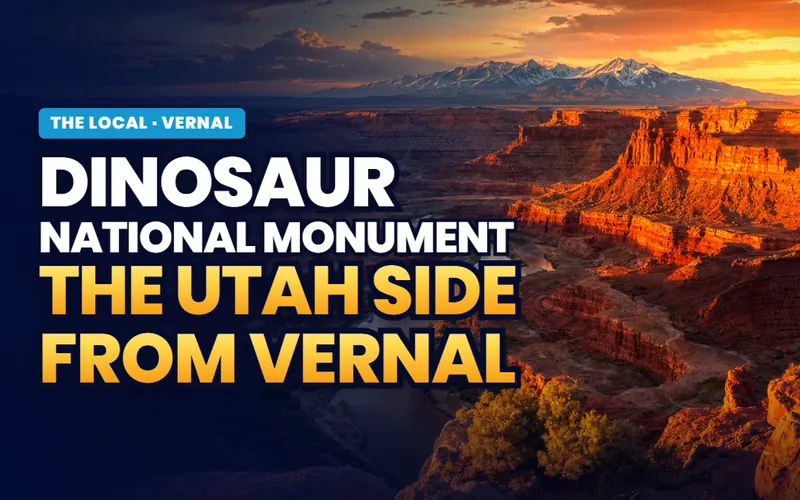 Dinosaur National MonumentThe quarry wall, the rock art, and the Cub Creek road.Read the guide
 Flaming GorgeThe reservoir and the dam about an hour north of town.Read the guide
 Red FleetDinosaur tracks on a reservoir north of town.Read the guide
 The Utah Field HouseThe state park museum on Main Street.Read the guide
 Living with the boomWhat an oil and gas county asks of a home buyer.Read the guide
Talk to Scott
Ready for your next step in Vernal?
My base is Southern Utah. So for a Vernal move, I connect you with a partner agent I trust for the work on the ground. I stay on your file for the homework and the loan side. You get a partner agent who knows the area, plus me in your corner.
How it works in Vernal
- A local agent on the ground.I connect you with a partner agent I trust near Vernal for the showings, the offer, and the closing.
- A second set of eyes.I stay on your file and do the homework on any home you are weighing, from the commute to the school boundaries.
- Real estate and lending, one person.I am licensed in both real estate and lending. On any one purchase I take one role. If I am your lender, I can tell you early if a home could be hard to get a loan on.
- A reply within one business day.Call or text, and I get back to you within one business day.
Or call me: (435) 357-4345I reply within one business day.

Referral disclosure. Outside Southern Utah, I connect home sellers and buyers with partner agents I trust in their area. If you choose to work with an agent I refer, that agent's brokerage pays my brokerage (Real Broker, LLC) a referral fee. The fee comes out of the agent's compensation; it is not an added cost to you. You are always free to choose any agent you wish, and using a referred agent is never required.